Most SEO guides treat internal linking like a housekeeping task. Add links where they feel natural, don’t go overboard, done. That advice is not wrong exactly, it just leaves 80% of the value on the table.
Internal linking is the closest thing to a free ranking lever you will ever find in SEO. You already own the pages. You control every link. No outreach, no budget, no waiting. Yet most sites are structured in a way that silently suffocates their own rankings, funneling PageRank into pages that don’t matter and starving the ones that do.
This guide fixes that. By the end, you will know exactly how to audit your internal links, restructure your site architecture, and build a linking system that compounds over time. No fluff. No generic advice.
First, Understand What Internal Links Actually Do
Before touching a single link, you need a clear mental model of what is actually happening under the hood. There are two things internal links do that move rankings:
1. They pass PageRank (link equity)
Every page on your site has some amount of PageRank, which is Google’s way of measuring importance and trust. When page A links to page B, it passes some of that authority over. This is the same principle behind why backlinks matter, except you control it entirely within your own site.
Think of PageRank like water flowing through pipes. Your homepage is the reservoir. Internal links are the pipes. If your pipes are badly designed, the water pools in the wrong places.
The implication: pages that receive more internal links, from stronger pages, rank better. This is not theoretical. It is documented in Google’s original PageRank patent and confirmed by countless SEO experiments.
2. They signal topical relevance
When you link from one article to another using descriptive anchor text, you are telling Google that these two pages are related. In 2026, with Google’s understanding of entities and topics far more sophisticated than it was five years ago, this matters more, not less. Internal links are a way to reinforce your topical authority and help Google understand what your site is genuinely an expert in.
The Audit: Find Out Where Your Internal Links Are Broken
Before building anything new, you need to understand your current state. Pull a site crawl using Ahrefs, Screaming Frog, or a similar tool. You are looking for four specific problems:
Orphan Pages
These are pages that exist on your site but have zero internal links pointing to them. Google may technically be able to find them via your sitemap, but they receive no PageRank and no topical context. They are invisible in practice. If you have any pages you want to rank, they cannot be orphans.
Link Depth
How many clicks does it take to reach your most important pages from the homepage? Three clicks is the accepted ceiling. If a key landing page is buried six levels deep, it is receiving a fraction of the authority it should. Shallow architecture wins.
Anchor Text Distribution
Export your internal links and look at what anchor text you are using. If your anchor text is mostly generic phrases like ‘click here’, ‘read more’, or ‘learn more’, you are wasting the relevance signal. Anchors should describe the destination page, ideally using the keyword or phrase that page is trying to rank for.
Link Hoarding on Low-Value Pages
Check which pages on your site have the most internal links pointing at them. If the answer is your privacy policy, your tag archive pages, or your contact form, something is structurally broken. Authority is pooling where it does not help you.
The Pillar-Cluster Model: The Architecture That Works
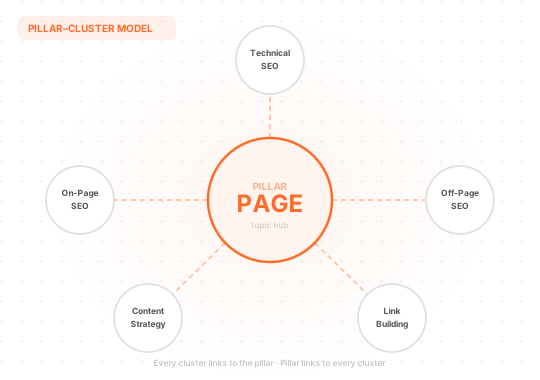
The most effective internal linking structure in 2026 is still the pillar-cluster model, but most implementations get it wrong. Here is how to do it right.
What It Looks Like
Pillar page: A long, comprehensive page that covers a broad topic. Think of it as the hub. For a digital marketing agency, this might be a page on SEO, covering what it is, why it matters, and what the key components are. Internally at PS Digital, Our AI SEO service page functions as this hub for the SEO topic cluster.
Cluster pages: Deeper, more specific pages that each cover one subtopic in detail. They link back to the pillar, and the pillar links out to them. For SEO, you might have separate cluster pages on technical SEO, on-page SEO, and off-page SEO, each linking back to the main SEO hub.
The golden rule: every cluster page links to the pillar. The pillar links to every cluster. Cluster pages cross-link with each other when it is genuinely relevant. That is the full circuit.
Why This Works
The model works because it does two things simultaneously. It concentrates authority on the pages that matter most (the pillars) and it signals to Google that your site has genuine depth on a topic. A site with ten tightly interconnected pages about SEO outranks a site with a hundred loosely connected pages every time.
Anchor Text: The Part Everyone Gets Wrong
Anchor text is where most SEOs either do too little or overcorrect in the wrong direction. Here are the rules that actually hold up:
Match the destination’s primary keyword, not a variation
If you are linking to a page targeting ‘technical SEO audit checklist’, use that phrase as your anchor. Not ‘click here for our checklist’. Not ‘our technical SEO page’. The actual target phrase. Google uses this signal directly.
Vary naturally across multiple links to the same page
If you have fifteen pages linking to your pillar, do not use identical anchor text on all fifteen. Mix exact match, partial match, and a handful of branded or generic anchors. This looks natural and avoids over-optimization flags.
Never use the same anchor for two different target pages
If ‘SEO audit’ always links to your audit checklist post, never use it to link to your audit service page. Conflicting signals confuse Google about which page should rank for that term.
The ‘Power Pages’ Tactic: Funneling Authority Where You Need It
This is the internal linking move that has the most direct impact on rankings, and it is almost never talked about in basic SEO content.
Identify your highest-authority pages. These are pages with the most backlinks pointing at them. In Ahrefs, sort your pages by Referring Domains. Your top ten or twenty pages are your power pages.
Find the pages you most want to rank. These are your commercial pages, your target landing pages, the ones generating leads or revenue.
Add contextual links from power pages to target pages. A blog post that attracts a hundred backlinks is sitting on a reservoir of authority. A single well-placed contextual link from that post to your services page passes more equity than most link-building campaigns produce in months.
This tactic works best when the link is contextually natural. Do not force it. If your high-traffic blog post is about technical SEO, a link to your technical SEO service page fits perfectly. Google rewards relevance.
What Changes in 2026: AI Search and Internal Links
The emergence of AI Overviews and LLM-driven search results adds a new dimension to internal linking strategy that most guides are not yet accounting for.
AI systems that summarize your content and surface it in search results tend to follow internal links to understand what else you have said on a topic. A well-linked site creates a complete picture that AI can reference and cite. A poorly linked site creates isolated islands of content that AI treats as incomplete sources.
The practical implication: your internal links now need to serve two audiences. Search engine crawlers as they always have, and AI systems that are reading your content to understand the full scope of your authority on a topic. Structured, logical, deep internal linking serves both. This is part of why a holistic SEO approach that integrates technical, content, and authority signals matters more in 2026 than it did even two years ago.
A Practical Implementation Checklist
Here is what to actually do, in order, after reading this:
- Run a crawl of your site and export your internal link data
- Identify and fix all orphan pages with at least two internal links each
- Check your click depth report and flatten anything beyond three clicks
- Map your topic clusters and confirm every cluster page links to its pillar
- Audit your anchor text and replace generic anchors with descriptive ones
- Pull your top backlinked pages and add links from them to your commercial targets
- Add internal links from any new content you publish before it goes live
- Review and update internal links on older high-traffic posts every quarter
The Compounding Effect
Internal linking is not a one-time task. It is a system. Every new page you publish creates new linking opportunities for older pages. Every new backlink your site earns increases the value flowing through your internal link network. The sites that win in competitive verticals are not necessarily the ones with the most backlinks. They are the ones where every piece of authority, earned or inherited, is directed efficiently toward the pages that matter.
Build the system once. Maintain it consistently. The rankings follow.
Need help auditing and rebuilding your internal linking structure? Get your free audit done today

Performance Marketing Lead at PS Digital. He breathes numbers, bends spreadsheets with macros, and plays the ROAS flute with style. Based out of Uttarakhand, he is obsessed with ROI and constantly nudges the cost per conversion lower across Google, Meta, LinkedIn, and Bing.
More from the blog.
Let's talk about your growth.
Get actionable digital marketing insights delivered, or work directly with our team on your strategy.