Picture this.
Your performance marketing team is running Google Ads. They have found a handful of keywords that are converting really well. Great cost per lead. Good quality enquiries. But that knowledge lives inside the ad account and nowhere else.
Meanwhile, your SEO team is writing content. Researching keywords. Building pages. Working hard to rank. But they have no idea which searches are actually bringing in customers, because that data is sitting in the ad account they do not have access to.
Two teams. Two budgets. Zero conversation between them. And the business is paying the price for it.
This is not a rare situation. It is the default for most Indian businesses running both SEO and paid media. And it is one of the most expensive inefficiencies in digital marketing, not because either channel is doing something wrong, but because they are not talking to each other.
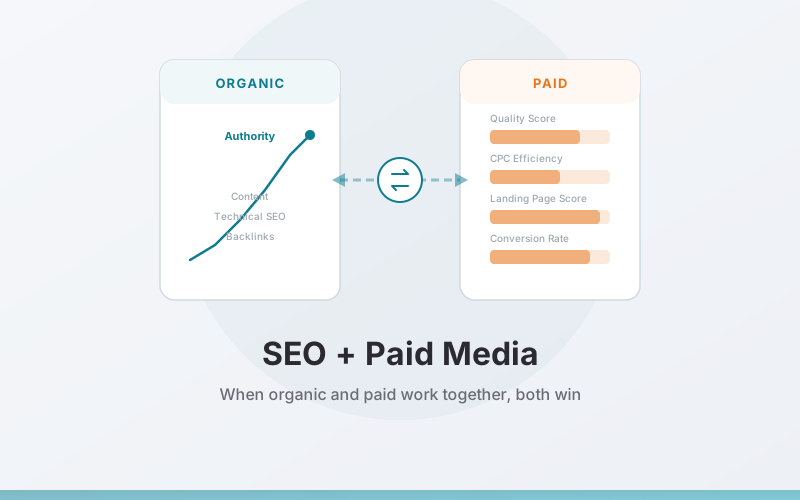
This article is about fixing that. Here is how SEO and paid media can work as one system, where each one makes the other sharper, cheaper, and more effective.
Why Keeping Them Separate Is Costing You
Let us be specific about what goes wrong when SEO and paid media work in silos.
The paid team picks keywords based on search volume and estimated CPC. They run ads, find the ones that convert, and optimise around those winners. Useful learning. But it stays trapped inside the ad account. Nobody passes it on.
The SEO team, working separately, builds content around keywords that look promising on paper. High search volume. Manageable competition. They invest months ranking for those terms. But some of those terms never convert. The traffic comes in and bounces out. Nobody told them which searches were actually worth chasing because the people who knew, the paid team, were never asked.
Both teams look productive. Both dashboards look fine. And the business is getting less than half the return it should from the combined investment.
Here is a useful way to think about it: organic search drives over half of all trackable website traffic, according to WordStream. Paid search drives a significant share of the rest. When those two streams do not share what they know about each other’s audience, you are navigating most of your marketing budget with one eye closed.
The good news is that the fix does not require a restructure or a new tool. It requires the two channels to share data and align on the same commercial goal. Here is how that works.
What Each Channel Can Give the Other (For Free)
Before we get into tactics, it is worth being clear about the actual value exchange between SEO and paid when they work together. This is not abstract. These are specific, real things each channel brings to the other.
Strategic Flow | Primary Benefit | Core Insight | Business Impact | Example / Application |
Paid Media informs SEO | Proof of what actually converts | SEO research shows search volume. Paid campaigns reveal conversion rate and revenue potential. | Prevents prioritizing high-volume keywords that do not drive revenue. Helps focus on terms with real buying intent. | 10,000 searches with no conversion history is weaker than 800 searches with a 6% conversion rate. The second keyword deserves SEO priority. |
SEO strengthens Paid Media | Lower cost per click | Well-optimized pages improve relevance, structure, and load speed, increasing Quality Score. | Higher Quality Score reduces CPC and improves acquisition efficiency. | In competitive Indian sectors like real estate, education, or insurance, where clicks cost ₹80 to ₹200, even a small Quality Score improvement reduces total ad spend significantly. |
SEO strengthens Paid Media | Warm audience for retargeting | Organic visitors have already demonstrated intent by searching and engaging with content. | Retargeting warm organic traffic is cheaper and converts better than targeting cold audiences. | Many businesses retarget paid visitors but ignore organic users, leaving a high-intent audience untapped. |
Paid Media validates SEO strategy | Faster testing before long-term investment | Paid campaigns provide quick conversion data before committing months to SEO efforts. | Reduces the risk of investing six months into pages that do not convert. | Run paid traffic for two weeks. If the page converts, scale with SEO. If not, redirect effort quickly. |
5 Ways to Make SEO and Paid Work as One System
Here is where this becomes practical. Each of these can be started this week, without a big process change or a new tool.
- Use Your Paid Data to Set Your SEO Priorities
Inside Google Ads, there is a report called the Search Terms Report. It shows you the exact phrases people typed into Google before clicking your ad and converting. Not keyword suggestions. Not estimated volumes. Real searches from real buyers who took action.
This is the most honest signal available for SEO prioritisation. If a search term is showing up repeatedly alongside conversions in your paid account, it is commercially proven. That is where your SEO effort should go next.
A UPSC coaching institute in Delhi was running Google Ads and noticed a pattern in their Search Terms Report. The phrase ‘UPSC coaching with test series included Delhi’ was generating enquiries at double the rate of the broader ‘UPSC coaching Delhi’ term they had spent months optimising their website for. Two weeks of paid data told them more than months of keyword research had.
Export your top-converting search terms from Google Ads every month. Build those into your SEO content calendar as your highest-priority targets. These are not guesses. They are revenue-proven searches that real buyers have already told you matter.
- Test Ad Headlines Before Writing SEO Content
A Google Ad headline and an SEO title tag do the same job: convince someone to click on you instead of everything else they can see on that page.
The difference is speed. Ad headlines can be A/B tested in a week with real data. SEO title tags take months to show any meaningful difference in performance. So if you want to know which headline angle your audience responds to, test it in paid first. Then carry the winner into your SEO.
This is especially useful in India, where language, tone, and cultural context vary significantly across regions. A headline that works in Mumbai may not land the same way in Coimbatore or Lucknow. Paid testing gives you fast, location-specific signal before you commit to it in your organic content.
When launching a new service page or content piece, run two ad variations with different headline angles to the same page for 7 to 10 days. Whichever drives a higher CTR becomes your title tag, your H1, and your opening line. You are applying what has already been proven to work, not guessing.
- Improve Your Landing Pages Before You Spend on Ads
Every rupee you spend on Google Ads is evaluated partly against the quality of the page the click lands on. This is called Quality Score, and it scores your keyword on three things: how often your ad gets clicked, how relevant the ad is to the search, and how good the landing page experience is.
A keyword with a Quality Score of 8 can cost 30 to 50% less per click than the same keyword with a Quality Score of 4, for the exact same ad position on the exact same results page.
The things that improve Quality Score are the same things that improve SEO: fast mobile load speed, content that directly matches the searcher’s intent, clear page structure, and a single focused action for the visitor to take. One investment lifts both.
Before launching paid traffic to any page, ask yourself three honest questions. Does it load in under 3 seconds on a mid-range Android phone? Does the first heading match exactly what the searcher was looking for? Is the content specific and genuinely useful, or is it generic enough to apply to anyone? If any answer is no, fix the page first. Your paid costs will drop and your organic rankings will improve at the same time.
- Retarget Your Organic Visitors with Paid Ads
This is one of the most cost-effective moves available to any business running both channels, and most Indian businesses are not doing it.
Your organic visitors have already demonstrated intent. They searched for something, found your content, and read it. They are warm. They are interested. They just have not converted yet.
A retargeting ad shown to this audience on Meta or Google Display costs a fraction of cold acquisition because the relevance is high and the audience is pre-qualified. You are not introducing yourself to a stranger. You are reminding someone who already knows you that they had not finished making a decision.
Think about the last time you searched for something, read a few articles, got distracted, and forgot to come back. A well-timed retargeting ad from one of those websites would have brought you straight back. That is exactly what this does, and it works especially well because the creative can be short, direct, and specific to what the person already read.
Set up a retargeting audience in Meta Ads Manager and Google Ads that captures all organic visitors from the last 30 and 60 days. Exclude anyone who has already converted. Build a simple, direct ad for this group that gives them one clear reason to come back and take action. These people already know who you are. They just need a nudge.
- Stop Paying for Rankings You Already Have
This one sounds obvious. In practice, almost nobody does it.
If your website is already ranking in the top 3 organic results for a keyword, you are getting that visibility for free. Running a paid ad on the same keyword means you are paying for clicks on a term you are already winning without spending anything. That budget would work harder somewhere else.
Flip it around too. For keywords where you have no realistic organic presence in the near term, because the competition is too strong or the domain authority is not there yet, paid is the right channel. Stop trying to out-rank national players on broad terms. Out-target them on specific, high-intent searches where you can win the conversion even if you cannot win the ranking.
The practical split: use paid for high-intent, bottom-of-funnel searches where someone is clearly ready to buy or enquire. Use SEO to build trust and educate over time for everything else. Stop the two channels competing on the same ground when they could be covering different ground together.
One More Thing: Google’s AI Has Raised the Stakes on Both Channels
Since Google expanded AI Overviews to India in 2025, the top of the search results page looks different. Many queries now return an AI-generated summary that answers the question directly, before the user needs to click anything. For businesses that built their SEO entirely around informational content, this has reduced organic click-through rates noticeably.
But here is what is interesting. Ads are now appearing inside these AI-generated summaries for commercially relevant searches. The brands getting that placement are the ones with strong Quality Scores and high-quality landing pages, exactly the signals built by good SEO. And the brands being cited organically inside AI answers are the ones with genuinely authoritative, well-structured content.
In other words: the brands that have connected their SEO and paid media into one system are getting visibility in both places simultaneously. The brands that kept them separate are competing harder for less space.
This is not a future shift to prepare for. It is happening right now in India across finance, education, real estate, and healthcare searches.
The Simple Truth About Running Both Channels
SEO and paid media are not rivals for the same budget. They are not alternatives you choose between. They are two channels that were always meant to inform each other, and when they do, both get cheaper and both get sharper.
Paid gives you fast proof of what works. SEO turns that proof into something that keeps working long after you stop spending. Organic traffic gives you warm audiences. Paid turns those warm audiences into customers at a fraction of cold acquisition cost.
You do not need to overhaul your entire setup to make this work. Pick one tactic from this article. Run it for 60 days. The results will make the case for the rest.
The businesses winning consistently in Indian digital marketing right now are not the ones with the biggest budgets. They are the ones whose channels are actually talking to each other.
If your SEO and paid media are running separately, you are leaving performance on the table. Get in touch with the PS Digital team.

Founder of PS Digital with 25+ years in digital marketing. Helps businesses build sustainable growth through SEO, paid media, and data-driven strategy.
More from the blog.
Let's talk about your growth.
Get actionable digital marketing insights delivered, or work directly with our team on your strategy.