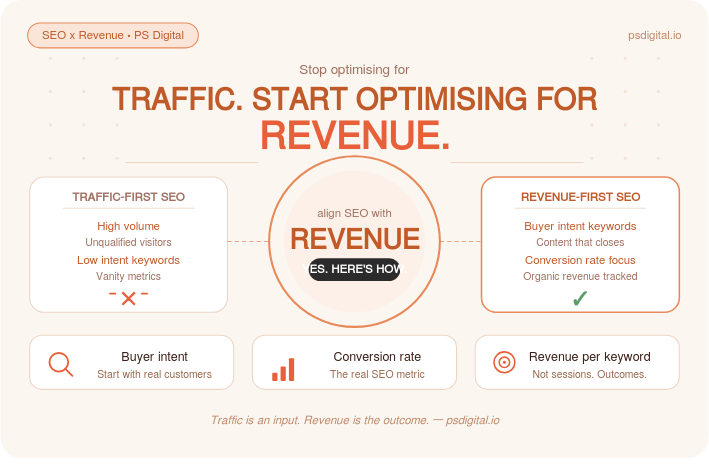
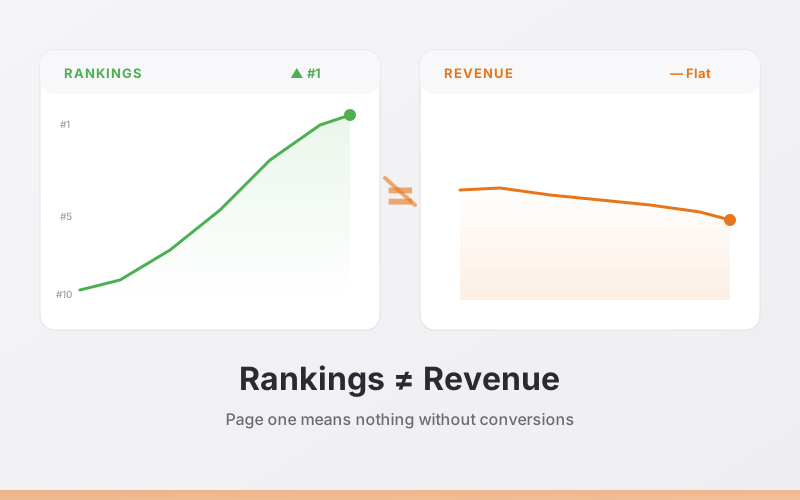
Most businesses treat SEO like a popularity contest. More clicks, more impressions, more people finding the site. The numbers go up, the team celebrates, and then someone asks the obvious question: why isn’t revenue going up too?
It’s a fair question. And the honest answer is that traffic and revenue are not the same thing. They never were. A thousand visitors who have zero intention of buying anything are worth less than ten visitors who are ready to pull out their credit card. SEO that is built around traffic will optimise for the former. SEO built around revenue will work harder to find the latter.
This shift in thinking changes everything, from which keywords you target to how you measure success. Here’s how to actually do it.
Start With Your Best Customers, Not Your Best Keywords
The typical SEO approach starts with a keyword tool. You find terms with high search volume, low competition, and off you go. The problem is that search volume tells you how many people are searching, not who they are or what they want to do next.
Revenue-aligned SEO starts somewhere different. It starts with your actual customers.
Look at the people who have already bought from you. What did they search before they found you? What problem were they trying to solve? What words did they use in their first email or during the sales call? These are the signals that matter. Real buyers leave a trail. Your job is to follow it backwards.
Once you have that picture, the keyword research you do will be filtered through a very different lens. You are no longer asking “what gets searched a lot?” You are asking “what do my best customers search right before they are ready to buy?”
Not All Keywords Are Equal, and That’s the Point
Here is a truth that gets lost in most SEO conversations: informational traffic and commercial traffic are completely different animals.
Someone searching “what is email marketing” is curious. They are reading, learning, exploring. They might become a customer in six months, or they might never come back. Someone searching “email marketing agency for SaaS startups” is in a very different headspace. They know what they want. They are comparing options. They are close to a decision.
Revenue-aligned SEO does not ignore informational content. But it is honest about what that content is for: it builds awareness, earns trust, and feeds the top of the funnel. The content that actually drives revenue is built around the terms that signal intent.
This is why a well-structured SEO strategy is not just about rankings. It’s about understanding what each page is supposed to do and making sure every piece of content has a clear job.
Your Funnel Has Gaps. SEO Can Fill Them.
Most businesses have a conversion problem hiding inside their traffic problem. Lots of people are landing on the site, but somewhere between arrival and checkout (or enquiry, or sign-up), people are falling off.
SEO can address this directly, but only if you think about it in terms of the buyer journey rather than just keywords. Each stage of the journey has different needs.
Someone who just discovered your product category needs education. Someone who is comparing you to a competitor needs specific, honest content about why you are the better choice. Someone who is almost ready to buy needs reassurance, social proof, and a clear next step.
When you map your content to this journey, you stop creating content that attracts the wrong audience at the wrong time. You start creating content that pulls people through the funnel instead of leaving them stranded halfway.
This kind of thinking is at the core of what a digital marketing strategy should actually deliver. Not a list of keywords to rank for, but a clear plan for how organic search fits into the path from first discovery to final conversion.
Conversion Rate Is an SEO Metric
This one surprises people. Most SEO practitioners will tell you their job ends at the click. Traffic is delivered, job done, the rest is someone else’s problem.
That is a deeply unhelpful way to think about it.
If you are sending 5,000 visitors a month to a landing page and 0.2% of them convert, that is not a paid media problem. That is a relevance problem. The wrong people are landing on that page, or the page is not speaking to what they actually came to find, or both.
Revenue-aligned SEO treats conversion rate as a feedback loop. Low conversions tell you something about the keyword, the page, or the match between the two. Fixing it is part of the SEO work, not someone else’s.
This is also why a digital marketing audit is often the most useful place to start. It shows you exactly where traffic is landing, where it’s leaving, and where the disconnects between intent and experience are costing you money.
Build Content That Closes, Not Just Content That Ranks
There is a category of content that ranks extremely well and converts almost no one. Generic guides, broad explainers, “ultimate” articles that cover everything and commit to nothing. These can drive traffic. They rarely drive revenue.
Content that closes looks different. It is specific. It speaks directly to a recognisable problem. It does not try to appeal to everyone. It anticipates objections and addresses them. It ends with a clear and relevant call to action.
One practical way to build this kind of content: talk to your sales team. They know what questions come up on every call. They know what makes people hesitate. They know the exact moment when a prospect becomes a buyer. That intelligence belongs in your content.
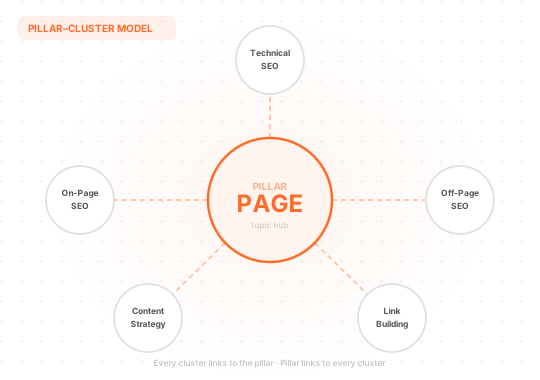
And while you are building that content library, pay attention to how pages link to each other. A smart internal linking strategy is not just a technical SEO task. It is a way of guiding visitors deeper into your site, towards the pages that are most likely to result in a conversion.
Stop Measuring What Doesn’t Matter
If your monthly SEO report leads with total organic sessions, you are measuring the wrong thing. Sessions are an input, not an outcome. What you actually want to know is how much revenue came from organic search, and what it cost to acquire each customer that way.
This means connecting your SEO data to your actual business metrics. That requires proper tracking setup, which most sites do not have. It also requires a willingness to admit that some of your highest-traffic pages might be your worst performers when measured by revenue.
That admission is where the real work begins. Once you know which pages are pulling their weight and which are just generating noise, you can make much smarter decisions about where to invest.
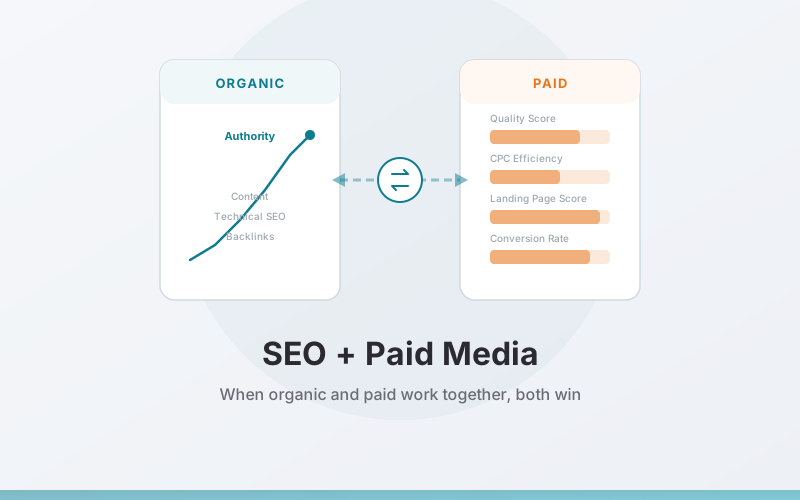
The same principle applies across channels. If you are running paid campaigns alongside your SEO work, the two need to be talking to each other. Misaligned messaging between organic and paid is one of the most common and avoidable reasons Google Ads campaigns underperform even when the SEO looks healthy.
The New Search Landscape Makes This Even More Urgent
Here is something worth paying attention to. The way people find information is changing faster than most SEO strategies are adapting. AI-powered search tools like Perplexity, ChatGPT, and Google’s own AI Overviews are increasingly answering questions directly, without sending the user to a website at all.
What this means is that generic informational content is going to deliver even less value going forward. If someone can get a complete answer from an AI summary, they have no reason to click through to your article about the same topic.
Revenue-aligned SEO is, coincidentally, far better positioned for this shift. Content that is specific, opinionated, and grounded in real commercial context is much harder for AI to replicate or summarise away. Content that speaks directly to a buying decision, names real concerns, and offers a clear perspective will continue to attract the right people. Understanding how to appear in AI search results is becoming as important as understanding how to rank on Google.
The Shift Is Simpler Than It Sounds
Aligning SEO with revenue does not require a complete rebuild of everything you have already done. It requires a change in what you use as your north star.
Traffic is easy to chase. It goes up when you publish more, build more links, and target more keywords. Revenue is harder. It goes up when the right people find you, understand what you offer, and trust you enough to take the next step.
Everything else in your SEO strategy, the content you create, the pages you build, the metrics you track, follows from which of those two things you are actually optimising for.
Choose the harder one. It’s the one that pays.

Performance Marketing Lead at PS Digital. He breathes numbers, bends spreadsheets with macros, and plays the ROAS flute with style. Based out of Uttarakhand, he is obsessed with ROI and constantly nudges the cost per conversion lower across Google, Meta, LinkedIn, and Bing.
More from the blog.
Let's talk about your growth.
Get actionable digital marketing insights delivered, or work directly with our team on your strategy.