Top 8 Landing Page Mistakes That Kill Your Conversions (With Fixes)
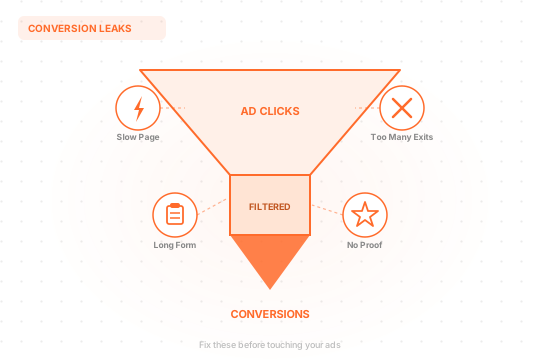
You are spending money on ads. Clicks are arriving. The weekly report shows healthy impressions, a decent click-through rate, and an audience that seems engaged. But actual revenue is not moving the way it should.
Here is the part most people do not want to hear: the ad is often not the problem. The landing page is.
The landing page is where your ad spend either turns into a customer or disappears. Google and Meta both evaluate landing page quality when deciding how much your ads cost and how widely they show. A weak landing page does not just hurt conversions. It raises your cost-per-click, shrinks your reach, and drains budget before a single sale comes through.
Every mistake in this post comes from real campaigns across real industries. Read through them. If several feel familiar, they are worth fixing before anything else in your ad account.
Mistake 1: The Ad and the Landing Page Are Telling Different Stories
Your ad makes a promise. The landing page has to keep it. When those two things are out of sync, the visitor loses trust within the first few seconds and leaves.
Picture a furniture brand running a Google ad for ‘Solid Wood Dining Tables Under 15,000.’ The user clicks, excited. They land on the brand’s homepage, which shows a rotating banner of bedroom furniture, a sofa collection, and a festive sale announcement. The dining tables are somewhere three scrolls down, buried in a category grid.
The user does not scroll three times looking for what the ad promised. They press back. The brand paid for that click and got nothing from it.
This is called message mismatch. It breaks the momentum the ad built. The user expected continuity and got confusion instead.
The Fix: Every campaign should point to a dedicated landing page that mirrors the ad’s exact headline, offer, and tone. If your ad promotes a specific product, a limited offer, or a free consultation, the landing page should open with that same thing, in the same language, without making the visitor hunt for it. The page should feel like the natural next step of the ad, not a fresh experience.
This is one of the first things we examine in a performance marketing audit. Mismatched messaging is almost always in the top three reasons a campaign underperforms, and it is one of the fastest things to fix.
Mistake 2: Too Many Choices, Too Many Exits
A landing page with a full navigation menu, links to other products, a blog section, and three different CTAs is not a landing page. It is a website. Websites are built for exploration. Landing pages are built for one decision.
Think of a skincare brand running Instagram ads for a new vitamin C serum. The ad is sharp, the creative is beautiful, the targeting is right. But it sends traffic to the main website, where the visitor is immediately confronted with eight product categories, a sale banner, a pop-up asking them to subscribe, and a navigation bar with fifteen options.
They came for a serum. They are now paralysed by choice. Or they click on something unrelated out of curiosity. Either way, they do not buy the serum.
Every additional option you give a visitor is a chance for them to do something other than convert. A navigation bar alone can reduce conversion rates by 20 to 30 percent on a paid traffic page.
The Fix: Remove the navigation bar from every page that receives paid traffic. Remove secondary links. Every element on the page should serve one purpose: move the visitor toward the single action you want them to take. If you are running five different campaigns, build five different pages. One goal per page is not a constraint. It is how conversions happen.
Mistake 3: The Page Is Too Slow, Especially on Mobile
Google’s data shows that as page load time increases from one second to three, the probability of a visitor bouncing rises by 32 percent. At five seconds, it reaches 90 percent. Nine out of ten visitors gone before your page has even finished loading.
Consider a coaching institute running Google ads for an MBA entrance prep course. The ads are well-written and the keywords are strong. But the landing page is image-heavy, built on an old website template, and takes six seconds to load on a mobile connection. Most students are browsing on their phones during commutes. The page never gets a chance.
The ads get blamed. The page is the actual problem.
The Fix: Run your landing page through Google PageSpeed Insights right now and look at the mobile score specifically. Target above 70. The most common culprits are large uncompressed images, third-party scripts loading before the page content, and bloated page builders. Converting images to WebP format and deferring non-critical scripts can cut two to three seconds off load time without rebuilding anything.
Mistake 4: The Headline Is About You, Not the Visitor
People click ads because they have a problem or a desire. When they land on your page, the headline needs to immediately confirm: you are in the right place, and here is what you get.
A headline that opens with your brand name, your years of experience, or your list of offerings does none of that. It makes the visitor work to figure out whether this page is relevant to them.
Take a real estate developer running ads for affordable flats in Pune. The ad copy is specific: ‘2BHK Flats Starting 45L, Possession 2025.’ But the landing page headline reads ‘Shreeji Builders: Crafting Homes With Trust Since 2003.’ The headline is about the developer. The visitor came because of the flats.
A good headline does three things: it tells visitors they are in the right place, names the outcome or desire they came for, and gives them a reason to read the next line.
The Fix: Write your headline from the visitor’s point of view, not your brand’s. The Pune developer’s page would perform better opening with ‘2BHK Flats in Pune Starting 45 Lakhs. Ready Possession, Zero Brokerage.’ That headline answers three questions in one line: what, where, and why act now. Test two or three headline variations. Even a small lift here compounds across every click the campaign receives.
Mistake 5: The Form Asks for Too Much Before Earning Any Trust
There is a direct relationship between the number of fields on a form and the number of people who complete it. More fields, fewer submissions. This holds true across every industry and campaign type.
An interior design firm running Facebook ads for home renovation projects built a landing page with a form asking for: full name, email, phone number, city, property type, budget range, timeline, and ‘describe your project.’ Eight fields before a single conversation has happened.
The visitors who were interested but not yet committed, which is most of them, did not fill it out. They were not ready to write a brief for someone they had just discovered thirty seconds ago.
The Fix: For paid campaigns, start with the minimum needed to begin a conversation. Name and phone number is often enough for a service business to make first contact. You can collect project details, budget, and timeline during the sales call. The form’s job is to lower the barrier to entry, not to pre-qualify every lead before you have given them any reason to trust you.
Mistake 6: Nothing on the Page Proves You Have Done This Before
Paid traffic is cold traffic. The person who clicked your ad has most likely never heard of your business before this moment. They are on your page in a quiet state of skepticism. The question they are asking, without realising it, is: ‘Can I trust these people?’
If your landing page answers that with nothing, you are asking strangers to convert on faith. Most will not.
A travel company running ads for Rajasthan honeymoon packages had a beautiful landing page with great photography and a clear itinerary. But there were no reviews, no couple testimonials, no mention of how many couples they had taken, no photos from actual trips. The page looked good but felt hollow.
Vague claims do not help either. ‘Trusted by thousands of happy travellers’ reads like filler. Specific proof is what moves people.
The Fix: Add proof that is concrete and believable. For the travel company: a photo from an actual couple’s trip with their first names and home city. A quote that mentions something specific about the experience. The number of honeymoon packages completed that year. One real, specific testimonial from someone who looks like your ideal customer is worth more than twenty generic star ratings. Make it easy for a cold visitor to see themselves in someone who has already made this decision.
Mistake 7: One Page Is Trying to Serve Every Type of Visitor
Not everyone who clicks your ad is at the same stage. Someone searching ‘best running shoes for flat feet’ is still exploring. Someone searching ‘buy Brooks Adrenaline GTS size 9 online’ is ready to purchase. Sending both to the same page treats two very different intentions as if they are identical.
This applies to Meta campaigns as well. A D2C protein supplement brand retargeting people who already added to cart but did not purchase needs a completely different page than the cold audience seeing the brand for the first time. The cart abandoner needs urgency and reassurance. The cold visitor needs to understand what the product is and why it is worth considering.
The Fix: Match your landing page to the intent level of the traffic. Search campaigns targeting high-intent keywords need pages with pricing, clear offer, and strong proof. Meta campaigns targeting cold audiences often convert better with an education-first approach or a low-commitment offer before asking for a purchase or a call. One campaign, one page, one job.
Mistake 8: The Thank-You Page Is a Dead End
Most thank-you pages say something like: ‘Thank you for your enquiry. We will get back to you soon.’ The visitor filled in your form, handed over their details, and the experience ends with a sentence that could have been written by a government office in 1997.
This is a significant missed opportunity. The moment right after conversion is the highest-trust moment in the entire funnel. The visitor just said yes to you. They are paying attention. They are in a cooperative, curious state of mind.
A premium fitness studio running ads for a free trial class had a well-optimised page that converted well. But the thank-you page was blank except for ‘Your booking is confirmed.’ The visitor had no idea what to expect next, whether to bring anything, how to reach the studio, or what the class would involve. Several did not show up because they were not sure it was real.
The Fix: Use the thank-you page to set clear expectations and extend the relationship. Tell them exactly what happens next: ‘You will receive a confirmation on WhatsApp within 10 minutes. Here is what to bring to your first class.’ Give them something useful: a short video, a relevant guide, a link to your best content. You can also invite a secondary action like joining a community group or following your page. The thank-you page is the one moment in your funnel where goodwill is highest. Do not waste it.
The Invisible Problem: You Cannot Fix What You Cannot See
All of the above assumes you actually know where visitors are dropping off. Without proper tracking, you are making decisions based on incomplete or incorrect data.
You need GA4 events firing correctly on form submissions, scroll depth data to see how far people read, and heatmap data from a tool like Microsoft Clarity showing where users click and where they stop. If your conversion tracking has not been verified end-to-end, the numbers in your weekly campaign report may be wrong.
Campaigns get optimised against flawed data and performance never improves. Everyone is busy looking at the ads. Nobody checks whether the conversions are even being counted correctly.
This is one of the first things a serious performance marketing engagement should address. If your current setup has not had a tracking audit, it is worth asking for one.
Where to Start
If you are running paid media right now, here is a practical starting point:
- Open your live ad and your landing page side by side. Does the headline on the page match the promise in the ad?
- Check whether your landing page has a navigation bar. If it does, it should not be there on a paid traffic page.
- Run a Google PageSpeed Insights test on your landing page and look at the mobile score.
- Count the fields on your enquiry form. If it is more than three or four, test a shorter version.
- Look at your thank-you page. Does it tell the visitor what happens next, or does it just confirm that something was submitted?
None of these are complicated. They do not require rebuilding your website or a major budget increase. They are fundamentals that get missed when the focus is entirely on what happens inside the ad platform. You can also explore our guide on Why Most Google Ads Campaigns Fail Before They Even Launch
A performance marketing partner worth working with treats the landing page as part of the system, not a separate concern. The ad and the page are one funnel. Getting one right while ignoring the other is like fixing half the leak.
If you want an honest look at where your funnel is losing money, PS Digital offers a free performance audit that covers the full picture, from ad structure to landing page to conversion tracking. Book one here.

Performance Marketing Lead at PS Digital. He breathes numbers, bends spreadsheets with macros, and plays the ROAS flute with style. Based out of Uttarakhand, he is obsessed with ROI and constantly nudges the cost per conversion lower across Google, Meta, LinkedIn, and Bing.
More from the blog.
Let's talk about your growth.
Get actionable digital marketing insights delivered, or work directly with our team on your strategy.