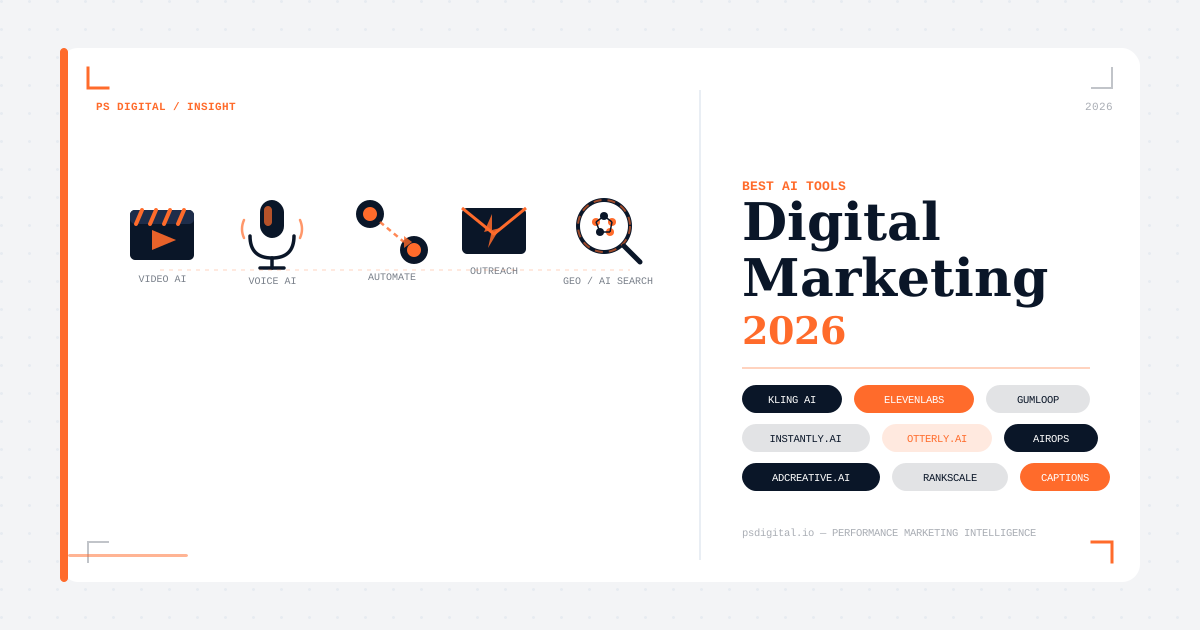
Not another list of ChatGPT and Canva. These are the tools real marketing teams are building workflows around right now.
Most guides on this topic read the same way. ChatGPT for writing. Canva for design. Semrush for SEO. Done.
That is not what this is. This guide goes deeper, into the specific tools that digital marketers, agencies, and performance teams are using day-to-day in 2026, many of which you have probably not seen in a top-ten list. Each one solves a real problem. Each one is already in someone’s paid stack.
The Frame: What AI Is Actually Doing for Marketers in 2026
Marketing in 2026 is about having the right data, giving AI instructions on how to interpret it, and building agents that can help you execute based on those inputs.
That is the real shift. AI tools are no longer content factories. They are infrastructure. The teams getting the most out of them are using AI to run the parts of marketing that used to require a full-time hire: competitor monitoring, content production at scale, video ad creation, cold outreach, GEO visibility. The strategy is still human. The execution layer is increasingly automated.
Here is what that looks like across each function.
For Video Ad Creative: Kling AI
If you are still building every video ad from scratch with a camera, actor, and editor, Kling AI is the tool that will change your perspective on production costs.
Kling 2.6, released in late 2025, fundamentally changed AI video creation. Previously, generating an AI video meant getting silent footage, then separately adding voiceovers, sound effects, and music. Now Kling generates everything in one pass, including speech, music, ambient audio, and sound effects, all synchronized to the visuals.
Its strongest use case is product marketing. Upload a product photo or character illustration, and Kling AI animates it. The quality with image inputs often exceeds text-to-video results because you are providing visual reference.
In head-to-head testing against Runway, Veo, and Sora across both generic and marketing-specific prompts, Kling O1 won on balance of quality, audio integration, and price. If you are creating two to three social media ads per week, Kling gives you room to experiment and iterate without anxiety about burning credits.
Paid plans start at $6.99 per month. All paid plans include commercial use rights. Free plan generations are non-commercial only.
Best for: E-commerce brands, D2C advertisers, and agencies producing short-form video ads for TikTok, Reels, and YouTube Shorts without a production team.
What to watch: Voice generation is strong in Chinese and English. Other languages still benefit from pairing with an external tool for voiceovers.
For Voiceover and Audio Production: ElevenLabs
ElevenLabs has expanded well beyond text-to-speech. The platform now integrates top video models including Veo, Sora, Kling, and Seedance, alongside its audio capabilities, with LipSync support to match AI voices to on-screen speakers, and Topaz upscaling that brings output to 4K. This positions ElevenLabs as a true end-to-end content creation platform.
The v3 model introduced emotional expression through audio tags. You can now specify tone, pacing, and emotion directly in your script. The voice cloning feature creates a digital replica of any voice from just a short audio sample, enabling consistent brand voices across all content. With support for 32 languages and various accents, ElevenLabs handles everything from podcast production to global ad campaign voiceovers.
The workflow many top performance marketers are running in 2026: Claude writes the script, Kling generates the video, ElevenLabs handles the voiceover, and everything is assembled in ElevenLabs Flows or CapCut. This workflow reduces post-production time by up to 70% compared to traditional stock footage editing.
Pricing: Free plan includes 10,000 characters per month. Starter plan is $5 per month with a commercial license and Instant Clone. Scale is $330 per month for higher volume teams.
Best for: Anyone producing video ads, podcast content, multilingual campaigns, or brand voice assets at scale.
For Marketing Workflow Automation: Gumloop
Gumloop is arguably the most underrated AI marketing tool available. Think of it as Zapier with a genuine AI layer, connecting any large language model to your internal tools and workflows without writing code. Major brands including Webflow, Instacart, and Shopify have adopted it for marketing operations. The recent MCP launch means Gumloop connects to virtually any marketing tool with intelligent, context-aware actions, a significant leap beyond simple trigger-based automations.
Real-world use cases: automated competitor intelligence reports, sentiment analysis on product reviews pulled from social media, weekly performance reporting, and content production pipelines that run without manual handoffs.
Gumloop runs entirely in the browser. You describe a flow in plain English or piece together nodes, hit run, and watch logs live with no API keys required for mainstream models. It comes with instant access to Anthropic and OpenAI tokens via platform keys and a visual debugger that pinpoints node failures without command-line work. It has a generous free tier with 1,000 credits per month.
Pricing: Starter is $97 per month for 30,000 credits, and Pro is $297 per month.
Best for: Marketing ops teams, agencies handling multiple client accounts, and anyone spending hours each week on repeatable tasks that follow a consistent pattern.
Honest caveat: Documentation lags behind feature rollouts, and the connector library for CRMs and analytics tools is still thinner than Zapier’s. Best suited for prototyping fast workflows.
For Cold Outreach at Scale: Instantly.ai
Instantly is a sales engagement platform built around cold email at volume. The core idea is scaling outreach without sacrificing deliverability. Most cold email tools cap you at single-inbox sending limits. Instantly routes campaigns across multiple inboxes from one dashboard, letting you scale without triggering spam filters.
The platform has evolved beyond cold email. It now includes a built-in B2B lead database called SuperSearch, a CRM module, AI reply agents, and a unified inbox called Unibox. But cold email remains its strongest suit.
For teams whose primary outbound channel is email, Instantly AI is one of the strongest tools available. The unlimited accounts, smart warm-up, and flat-fee pricing make it hard to beat at its price point. Growth plan starts at $37 per month.
What it does well: Volume cold outreach with deliverability management. The warmup system, inbox rotation, and campaign builder are genuinely well-built.
What it does not do: Instantly tells you nothing about which prospects are actually interested. There is no intent signal detection or AI-driven prioritization. You are essentially spray-and-pray with better automation. If you need multichannel outreach including LinkedIn, you will need Lemlist or Apollo alongside it.
Best for: Agencies running cold outreach for clients, and sales teams whose primary channel is email at volume.
A strong performance marketing operation treats cold outreach as one input, not the whole strategy. Instantly handles the mechanics well. Your targeting, message, and offer still have to do the real work.
For AI Search Visibility (GEO): Otterly.ai and Rankscale
This is the category most marketers are not paying attention to yet, and that is exactly why it is worth paying attention to now.
When someone asks ChatGPT, Perplexity, or Google’s AI Mode which agency to hire, which product to buy, or which tool to use, your brand is either being recommended or it is not. Traditional rank tracking tools cannot see this. GEO tools can.
Rankscale offers the most affordable entry into GEO tracking with a flexible credit-based model starting at $20 per month. It tracks ChatGPT, Claude, Perplexity, and Google AI Overviews with region and keyword-specific monitoring. Features include a brand dashboard with Visibility Score, citation analysis showing which sites are being cited instead of yours, and AI Readiness Score audits. The founder-led team ships updates multiple times per week based on community feedback.
Otterly.ai makes GEO monitoring accessible with an entry-level plan at $25 per month. It tracks brand mentions and citations across six AI engines with automated weekly reports.
For teams wanting to go deeper: AirOps 2.0 introduced tools for assessing topical authority and engineering content for AI citation. The platform enables data-enriched articles with proper schema markup that AI systems prefer, comprehensive topic clusters, and E-E-A-T optimization at scale. Case studies report 20-fold organic traffic growth by systematically creating content that AI search engines prioritize.
Best for: Any brand or agency that wants to know whether they are showing up when AI tools answer questions in their category.
This is where SEO strategy is heading. The question is no longer just “where do we rank on Google?” It is “are we being cited when AI answers a question our customer would ask?”
For Content Production at Scale: AirOps
AirOps is an AI platform for SEO and content teams that want to turn research into optimized copy at scale. It excels at workflow automation, brand-aware briefs, and content refreshes tied to SERP data. If you manage ongoing blog posts or product pages and need consistent, high-quality content, AirOps helps systematize the process from brief to publish.
It offers templates for content briefs, optimization, and refreshes, a workflow builder for repeatable SEO tasks, Knowledge Bases for brand consistency, and CMS integrations to push work live without friction.
Case studies report five times faster content refreshes and twenty times traffic growth for teams using AirOps to create content that AI search engines prioritize.
Honest caveat: The cost structure can surprise you. Task overages are billed at $0.025 per task on some plans, which adds up during content sprints. Confirm current pricing on their site before committing. It is also better suited to teams with an established content strategy. If you are still figuring out what to write, AirOps gives you a very efficient way to produce the wrong content at scale.
Best for: Agencies and in-house SEO teams producing high volumes of content who need a repeatable, auditable system.
For Short-Form Video Editing: Captions App
Captions has become the go-to tool for short-form video creators. It automates the tedious parts of video editing for TikTok, Reels, and YouTube Shorts using OpenAI’s Whisper model for highly accurate transcription, producing those viral word-by-word animated captions perfectly timed with speech. The AI Edit feature automatically adds zooms, transitions, B-roll, and sound effects based on your content. Features like AI Eye Contact (which subtly adjusts your gaze to look at the camera) and Studio Sound (which removes background noise) solve real production problems creators face daily.
For brands producing organic social content or running Facebook Ads with video creative, Captions removes a production bottleneck that used to eat hours every week.
Best for: Social media managers, content creators, and anyone producing short-form video who wants to spend time on ideas, not on editing.
For Paid Search Creative and Copy Testing: AdCreative.ai
AdCreative.ai focuses specifically on performance advertising creative, generating ad banners, social ads, and video variations optimized for conversions. It is built for performance marketers and media buyers who need high volumes of creative variations for testing. Self Made Millennials –
The key use case is not generating one great ad. It is generating enough variation to find the one that actually works. For Google Ads teams running responsive search ads and display, having more starting material to test from is almost always better than fewer, more polished options.
Best for: Media buyers and performance teams who run continuous creative tests and need volume without a design team bottleneck.
A Practical Stack by Budget
Rather than telling you to buy all of the above, here is how to think about building a real stack:
Starter ($50 to $200 per month): Rankscale for GEO monitoring ($20), Otterly.ai for citation tracking ($25), Captions for video editing (free to low cost), and Kling AI for video ad production ($7 to $15). This stack gets you into AI video creation and AI search visibility for under $100 a month.
Growing agency ($300 to $700 per month): Add Gumloop for workflow automation ($97), Instantly.ai for cold outreach ($37), and ElevenLabs for voiceover ($5 to $22). You now have outreach, video production, and automation covered.
Content-heavy operation ($700+ per month): Layer in AirOps for content at scale, and start exploring the deeper GEO tools like Profound or Scrunch.ai for enterprise-level visibility tracking.
One tool with a clear owner will always outperform five tools with none. The marketers getting the most value from AI tools are the ones who can validate, interpret, and tune AI outputs, not just the ones who subscribe to the most platforms.
If you are thinking about where AI fits into your broader digital marketing strategy, the honest answer is: everywhere, eventually. But you do not need to be everywhere at once. Start with your biggest time bottleneck, pick the right tool for it, and build from there.

Performance Marketing Lead at PS Digital. He breathes numbers, bends spreadsheets with macros, and plays the ROAS flute with style. Based out of Uttarakhand, he is obsessed with ROI and constantly nudges the cost per conversion lower across Google, Meta, LinkedIn, and Bing.
More from the blog.
Let's talk about your growth.
Get actionable digital marketing insights delivered, or work directly with our team on your strategy.