Why Most Google Ads Campaigns Fail Before They Even Launch
You set a budget. You pick some keywords. You write a couple of ads. You hit launch and wait.
A week later, you have spent thousands of rupees, got a few clicks, but zero enquiries. You tweak the ads. Still nothing. Either you pause the campaign or you hand it to an agency who makes the same changes and gets the same result.
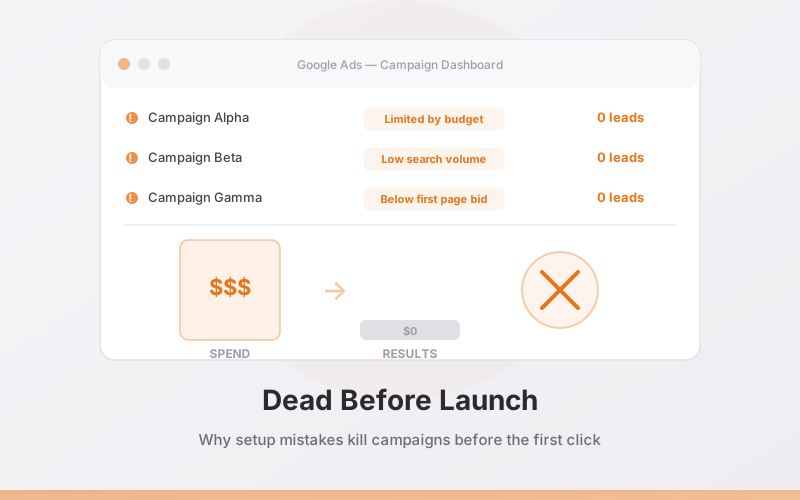
Here is what nobody tells you: the campaign was already failing before it went live. Not because Google Ads is too expensive for India. Not because your competitors have bigger budgets. Because the foundation underneath the campaign had holes in it.
In India, Google Ads clicks on search are relatively affordable, typically between ₹20 and ₹100 per click depending on your industry. Real estate, finance, and education push higher. But even at ₹30 a click, a ₹15,000 monthly budget only gets you around 500 clicks. If you have not done the thinking before launch, those 500 clicks will produce nothing and you will walk away believing Google Ads does not work.
It works. The foundation just was not ready.
1. You Do Not Know What a Customer Is Actually Worth
Before building any campaign, you need one number: the maximum you can spend to get one paying customer and still make money. This is called your target CPA, or cost per acquisition.
Without this, there is no logical way to set a budget. Most Indian businesses set ad budgets based on what feels affordable that month, not on what the maths actually supports. That is not a strategy. It is a guess with a payment method attached.
Example: A coaching institute in Pune charges ₹18,000 for a course. Their margin after delivery costs is about ₹8,000. They ran Google Ads with a ₹500/day budget. After three weeks: 12 enquiries, 1 enrolment. They concluded that Google Ads is too expensive for their business.
What they never worked out was this: at ₹8,000 margin per student, they could have spent up to ₹2,500 acquiring each one and still been profitable. Their actual cost per acquisition was ₹10,500 because the budget was too thin to generate enough volume, and no one had calculated the target before spending.
Fix this first: Calculate your customer’s value over 3 months, not just the first transaction. Work out how much you can pay to acquire one. Then build your budget around that number, not the other way around.
2. Tracking Is Set Up Wrong, and Nobody Checked
This is the most common and most invisible problem we find when auditing failing Google Ads accounts in India.
Conversion tracking is how Google learns which clicks turn into leads or sales. When tracking is broken, the algorithm is flying blind. It will spend your budget confidently every day and learn absolutely nothing useful from it.
Broken tracking is not always obvious. Sometimes it fires on the wrong page. Sometimes it counts every website visit as a conversion. Sometimes it works on desktop but not on mobile, which matters a lot given that over 75% of Google searches in India happen on smartphones.
A broken tracking setup is often invisible on the surface. The account dashboard shows conversion numbers. Those numbers just do not match anything real. We have audited accounts in India where the campaign reported 80 conversions in a month and the client had received 6 actual enquiries. The algorithm had been optimising for ghost data for months.
What to do: Before launch, manually fill out your own enquiry form, call your own number through the ad, or complete a test purchase. Confirm it shows up in the Google Ads dashboard in real time. This takes two hours. Skipping it can cost months of wasted budget.
3. Your Keywords Attract the Wrong Type of Searcher
Not every search means the same thing. Someone typing ‘what is term insurance’ and someone typing ‘buy term insurance plan online’ are in completely different places in their decision. One is curious. The other is ready to act.
Most campaigns lump these together. They target broad, high-traffic keywords because the search volume looks impressive in the keyword planner. What they get is a lot of people who are researching, comparing, or just browsing.
Here is the real issue in India specifically: competition on broad keywords in categories like education, real estate, healthcare, and financial services is intense. Multiple national players are bidding aggressively. A smaller business bidding on ‘MBA colleges in India’ is competing with big private universities and national education platforms with massive budgets. It will lose that auction badly, or pay far more than the click is worth.
The more specific the search, the closer the buyer is to a decision. ‘MBA college in Nagpur under 2 lakhs fees’ is lower volume but far more valuable per click. The intent is clear. The competition is lower. The conversion rate is higher.
Fix this: Segment your keywords by buying intent, not just topic. Separate people who are exploring from people who are ready to enquire or purchase. Give each group its own ads, its own bids, and its own landing page.
4. The Offer Is Generic
Open Google right now and search for any service in your industry. Read the ads that come up. The chances are very high that they all say roughly the same thing. ‘Get a free quote.’ ‘Call us today.’ ‘Trusted since 2010.’ ‘India’s leading…’
None of that is an offer. It is filler. It gives the person searching zero specific reason to click your ad over any other.
A real offer addresses a specific fear or desire the customer has at that exact moment. If your customer is worried about hidden charges, you address transparent pricing. If they are worried about wasting time on a bad product, you offer a free trial or demo. If they are comparing multiple vendors, you give them a reason to stop comparing.
The ad is the headline. The offer is what earns the click, and more importantly, what earns the conversion once they land on your page.
Before writing a single ad: List the top three things your customer is nervous about when they search for what you sell. Build your ad copy around removing those fears. That is what separates a high-performing ad from one that gets scrolled past.
5. The Landing Page Kills the Sale
The ad makes a promise. The landing page either keeps it or breaks it. When it breaks it, the visitor leaves in under 10 seconds and you have paid for that click with nothing to show for it.
The most common mistake: sending paid traffic to your homepage. A homepage is built to give visitors an overview of your entire business. A landing page is built to convert one specific type of visitor who arrived with one specific intent.
When someone in Chennai clicks an ad for ‘interior designers for 2BHK flat’ and lands on a homepage with a slideshow, an about us section, and eight menu options, they leave. The back button is right there and your competitor is the next result.
Research consistently shows that businesses using dedicated, campaign-specific landing pages see conversion rates more than double compared to those sending traffic to their homepage. Same budget, same clicks, more than twice the results. The page, not the ad, is often where campaigns are won or lost.
Your landing page needs to do three things in the first five seconds: confirm the visitor is in the right place, tell them clearly what they get, and make it simple to take one action. That is it.
Check this before launch: Read your landing page as someone who has never heard of your business. Is it immediately clear what you offer, who it is for, and what happens when they click the button? If you hesitate, so will your customer.
6. The Budget Cannot Generate Enough Data to Work
Google Ads gets smarter the more conversion data it has. This is not optional, it is how the platform is built. Google’s own guidance recommends at least 30 to 50 conversions per month per campaign for its Smart Bidding to function reliably.
Smart Bidding is where you tell Google to optimise your ads for conversions rather than just clicks. Below that conversion threshold, the system is essentially making educated guesses.
The pattern we see constantly in India: a business runs a campaign with a ₹200 to ₹300 per day budget, gets 4 to 6 conversions in a month, pauses the campaign to ‘review it’, then relaunches. Every relaunch resets the learning period. The algorithm never stabilises. Performance stays inconsistent. The business concludes Google Ads is unpredictable.
It is not unpredictable. It is underfed.
The fix is counterintuitive: run fewer campaigns with more budget behind each one. One well-funded campaign that generates 40 conversions per month will outperform four thin campaigns that each generate 10. Scale your segmentation later, once volume grows.
What to Check Before You Launch Anything
A pre-launch review does not need to be complicated. It needs to be honest. Run through these six points before any campaign goes live:
Economics: Do you know your target CPA? Does your daily budget, divided by your expected cost per click, give you enough clicks to realistically generate conversions?
Tracking: Has every conversion action been manually tested and confirmed inside Google Ads in real time? Does it work on mobile, not just desktop?
Intent: Are high-intent, decision-ready searches separated from research-phase searches, with different ads and bids for each?
Offer: Does each ad speak to a specific fear or desire the customer has, or is it a generic instruction to ‘call us’?
Landing page: Does the page match the exact promise of the ad and push toward one clear action within the first five seconds?
Volume: Does the campaign structure allow for enough monthly conversions to actually generate data the algorithm can learn from?
If any of these have an honest ‘no’ against them, the campaign is not ready to launch yet.
Google Ads Is a Multiplier, Not a Fix
The businesses that get strong, consistent results from Google Ads in India are not the ones who found a clever bidding trick. They are the ones who built the right foundation before touching the platform.
Google Ads takes what is already there and amplifies it. A clear offer, accurate tracking, a strong landing page, and sensible economics will scale beautifully with the platform. Weak assumptions, broken tracking, and a homepage from 2019 will scale badly, at whatever daily budget you set.
Most campaigns that fail were not failed by Google. They failed in the week before launch, in the assumptions, shortcuts, and skipped steps that felt small at the time.
Fix the foundation. Then turn the ads on.
If your Google Ads are spending but not converting, the problem is almost never the ads. Reach out for a free account audit.

Performance Marketing Lead at PS Digital. He breathes numbers, bends spreadsheets with macros, and plays the ROAS flute with style. Based out of Uttarakhand, he is obsessed with ROI and constantly nudges the cost per conversion lower across Google, Meta, LinkedIn, and Bing.
Let's talk about your growth.
Get actionable digital marketing insights delivered, or work directly with our team on your strategy.