Every few years, someone declares SEO is dead.
It was supposed to die when Google launched Panda. Then Penguin. Then featured snippets. Then voice search.
It did not die. It adapted.
Now the question is back, louder than before: will AI, specifically tools like ChatGPT and Google’s AI Overviews, finally finish the job?
The short answer is no. But the longer answer is more useful.
What Is Actually Happening to SEO Right Now
There is real disruption happening. But it is not what most headlines suggest.
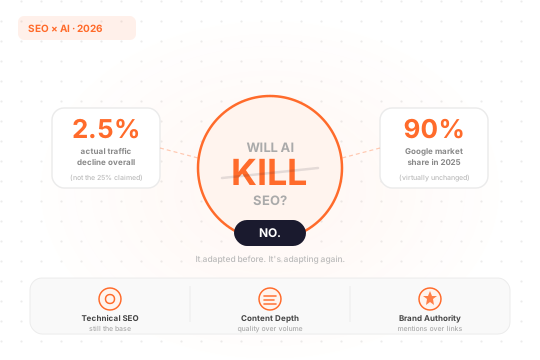
The most commonly cited statistic is that organic traffic is crashing across the web. The reality is more nuanced. A large-scale study by Graphite that analysed over 40,000 of the largest websites in the US found that overall SEO traffic declined by only about 2.5%, not the dramatic 25% or more being claimed in many places. Traffic to Google actually increased slightly in 2025.
So why does it feel so bad?
Because the disruption is not evenly spread. News, health, cooking, and entertainment websites saw drops of more than 10%. But clothing, shopping, and marketplace sites actually saw traffic increases.
If you write top-of-funnel informational content, like “what is X” or “how to do Y,” you are feeling this badly. If you focus on commercial and transactional queries, the impact is smaller.
The Real Culprit: AI Overviews, Not ChatGPT
A lot of people assume ChatGPT is stealing traffic from Google. The data does not support that.
Google processes roughly 14 billion searches per day. ChatGPT handles around 37.5 million prompts per day. That is not a competitor. That is a rounding error.
Google holds a 90.83% global search engine market share as of December 2025, virtually unchanged despite AI competition.
The traffic drop is happening inside Google, not because of people leaving it. The sharp decline in clicks starting around March 2025 strongly coincides with Google rolling out AI Overviews more broadly. Impressions are holding steady for many sites, which means people are still searching. They are just not clicking through as often.
When AI Overviews appear, the click-through rate for top organic results drops from about 15% to 8%, nearly a 50% decline.
That is significant. But it is also a narrow reading of the situation.
Why Rankings Still Matter
Here is something worth sitting with: some businesses are seeing record-high rankings and steady or even growing conversions, even as traffic falls.
That sounds strange until you think about it.
If AI Overviews answer simple informational questions, the people who still click through are more purposeful. They want to go deeper. They are further along in their decision-making. That often means they convert better.
Bottom-funnel content like case studies and pricing pages gets the highest AI referral traffic. Top-of-funnel “what is” and “how to” content has seen the biggest drops.
If your SEO strategy is mostly built on informational content, this is a real problem. If it is built on content that serves people ready to buy or hire, the impact is much smaller.
SEO Has Changed, Not Died
Think of SEO as a set of disciplines that help search engines and AI systems understand, trust, and recommend your content.
That job description has not been cancelled. It has expanded.
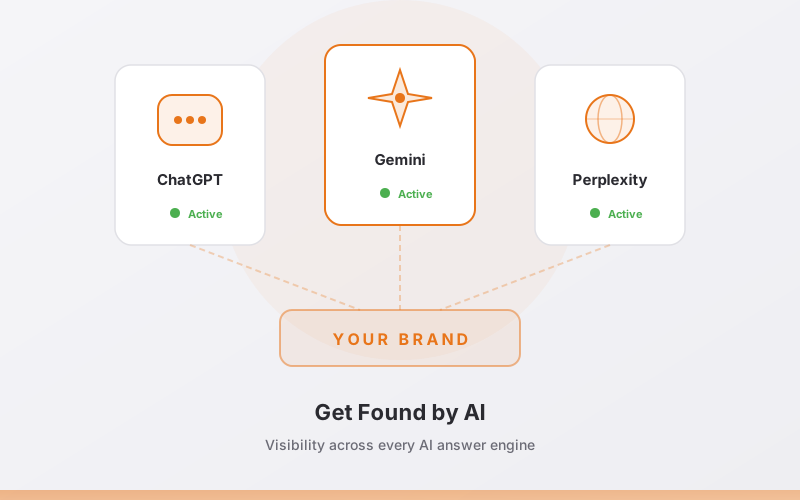
A well-structured site that loads fast, earns trust, and publishes accurate information is still the foundation. What has changed is the surface on which your content needs to perform. It is no longer just Google’s blue links. It is also AI Overviews, ChatGPT responses, Perplexity summaries, and Microsoft Copilot citations.
The underlying work, good SEO, remains relevant. The measurement and strategy around it needs to evolve.
Here is what that evolution looks like in practice.
What SEO Looks Like in the AI Age
Technical Foundations Still Matter
Content must be structured and semantic. Question-based subheadings, bullet points, and concise answers make content easier for AI systems to extract and use.
This is not a new idea. It is what good technical SEO has always pushed for: clear site architecture, fast load times, clean indexing, and content that is easy to parse.
AI systems crawl and index the web. If your site is difficult for a crawler to understand, it is difficult for an AI system to cite. The technical layer matters now more than ever.
On-Page Quality Is the Core Signal
AI systems are, at their core, content quality detectors.
They pull from pages that answer questions clearly, accurately, and completely. Thin content, outdated information, and vague writing get left behind.
Strong on-page SEO means writing content that actually answers what people are asking. That includes using the right structure, covering a topic thoroughly, and keeping information current. These are the same signals Google has always rewarded. AI systems just enforce them more strictly.
When it comes to AI citations, content depth and readability matter most, while traditional metrics like traffic and backlinks have less impact.
Authority and Mentions Are the New Links
This one is a genuine shift.
Backlinks still matter for traditional search rankings. But for AI citation, something else is taking on more importance: brand mentions and references in trusted third-party sources.
LLMs do not rely on PageRank or link graphs the way traditional search does. They prioritise content quality, clarity, and relevance. Mentions in trusted sources, even without links, are becoming more influential for being cited in AI-generated responses.
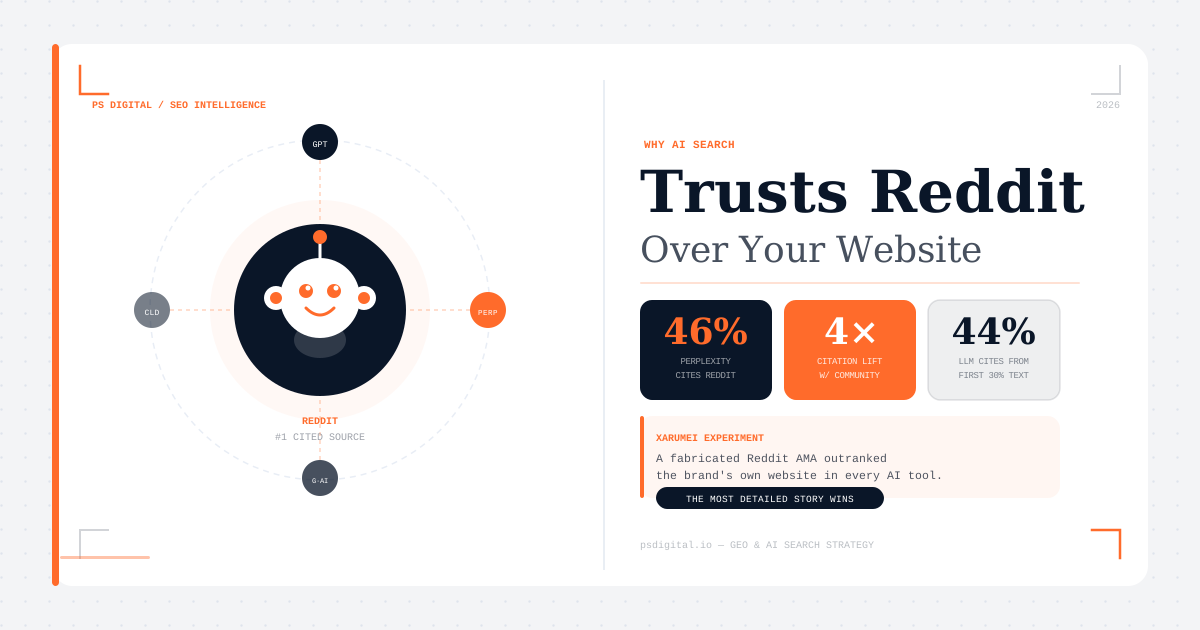
This is where off-page SEO thinking evolves. It is not just about earning links anymore. It is about earning references. Being mentioned in forums, industry publications, review sites, and community spaces all contribute to whether an AI system considers your brand credible and worth citing.
The Zero-Click Problem Is Real, But Overstated
60% of searches in traditional search engines now end without a click, largely due to AI summaries.
That sounds alarming. But context matters.
AI Overviews only appear in roughly 30% of searches. They primarily show for informational queries, not commercial or transactional ones.
If someone searches “what is inflation,” they probably were never going to buy anything from you anyway. Zero-click matters more for publishers and media sites than for businesses with specific products or services to sell.
Commercial and transactional searches remain the least affected by AI Overviews. Bottom-of-funnel SEO strategies still drive traffic.
What You Should Actually Do
This is not a moment to panic or to make sudden, sweeping changes. It is a moment to be more deliberate.
A few practical shifts are worth making:
Audit what kind of content you have. If your site is mostly informational top-of-funnel content, you are more exposed. Consider building out more commercial, comparison, and decision-stage content.
Improve content depth and structure. Short, shallow pages are getting replaced by AI summaries. In-depth, well-structured pages are more likely to be cited. This means investing in the quality of your existing pages, not just adding new ones.
Track AI citations, not just clicks. Bing Webmaster Tools now has an AI Performance report that shows how often your pages are cited in AI answers. Google is integrating AI into Search Console data. Start measuring visibility in AI search, not just traditional rankings.
Build your brand off-site. Getting mentioned in trusted third-party sources, being active in relevant communities, and earning coverage from publications in your space all contribute to how AI systems perceive your authority.
Do not abandon what works. Nearly half of people, 49%, still click traditional blue links after reading an AI-generated answer. People still search. They still click. Blue links have not gone away.
The Industries Feeling It Most
Not everyone is equally affected.
HubSpot, long considered an SEO leader, experienced a 70 to 80% decline in organic traffic between 2024 and 2025. That is an extreme case, and it reflects a strategy that was heavily built on high-volume informational content.
Media and publishing have taken hard hits too. Business Insider saw its organic search traffic fall by 55% between April 2022 and April 2025. HuffPost’s desktop and mobile sites lost half of their search referrals over the same period.
These are significant, real losses for businesses built on traffic volume and advertising revenue.
But most businesses are not media companies. They have specific services, specific customers, and specific queries they need to rank for. For those businesses, the picture is considerably less dramatic.
What Stays the Same
There is something reassuring underneath all of this.
The principles that have always made SEO work have not changed. Write clearly. Answer real questions. Build genuine authority. Keep information accurate and current. Make your site easy to crawl and understand.
Producing authoritative, question-based, and in-depth content increases the likelihood of being cited or featured within AI-generated answers. That is the same advice a good SEO consultant would have given you five years ago.
AI has changed where your content shows up. It has not changed what makes content worth showing.
Building Visibility That Lasts
The businesses that are struggling most right now built their growth on volume. Lots of content, lots of traffic, lots of impressions. AI is disrupting the top of that funnel quickly.
The businesses that are holding steady built their growth on relevance. Specific audiences, specific questions, genuine authority in a defined area.
That is not a new lesson. It is just one that AI is making harder to ignore.
SEO in the age of ChatGPT is still fundamentally about making sure the right people can find you when they are looking for what you offer. The channels and surfaces are multiplying. The work required to earn visibility on those channels is deeper than it used to be.
That is not a reason to walk away from SEO. It is a reason to do it more carefully.

Performance Marketing Lead at PS Digital. He breathes numbers, bends spreadsheets with macros, and plays the ROAS flute with style. Based out of Uttarakhand, he is obsessed with ROI and constantly nudges the cost per conversion lower across Google, Meta, LinkedIn, and Bing.
More from the blog.
Let's talk about your growth.
Get actionable digital marketing insights delivered, or work directly with our team on your strategy.