SEO has always evolved. But what is happening in 2026 is not a routine update or an algorithm tweak. It is a structural change in how people find information and how search engines decide what to show them. If your SEO strategy still looks the same as it did in 2023, you are optimizing for a version of search that is already behind you.
This article breaks down exactly what has shifted, which signals now carry the most weight, and what a winning SEO strategy actually looks like when AI is sitting at the center of the search experience.
Search Has a New Middleman: The AI Answer Layer
For most of the internet’s history, search worked the same way. A user typed a query. A search engine returned a list of links. The user clicked through. Traffic flowed.
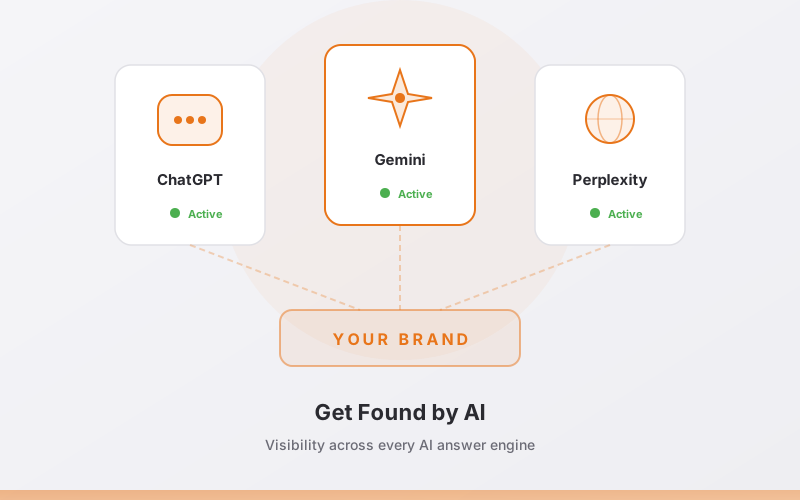
That model is being replaced, not entirely, but meaningfully. AI-powered answer engines, including Google’s AI Overviews, Perplexity, ChatGPT with search, and Gemini, now intercept millions of queries and return direct answers before a single link is clicked.
The implication for SEO is significant. Ranking on page one no longer guarantees visibility. If an AI answer layer sits above your result and answers the question without the user needing to click, your traffic potential from that query drops sharply.
The goal of SEO in 2026 is not just to rank. It is to be the source that AI answers draw from. That requires a different type of content, a different type of authority, and a different relationship with how search engines understand your brand.
The 4 Signals That Matter Most in 2026
Not all SEO signals carry equal weight anymore. Here are the four that have risen to the top as AI search has matured.
Topical Authority Over Keyword Density
Google and AI retrieval systems no longer reward pages that repeat a keyword many times. They reward websites that demonstrate genuine depth and breadth on a subject. A brand that has covered every meaningful angle of a topic, with connected, well-structured content, will consistently outperform a brand chasing individual keywords in isolation. Think in topic clusters, not single pages.
Structured Content That AI Can Extract
AI systems are not just ranking your content. They are reading it, parsing it, and pulling specific sentences out to construct answers. Content that uses clear headings, concise declarative statements, FAQ formats, and schema markup is far more likely to be cited in AI-generated answers than content written as long, unbroken marketing copy.
Entity Recognition and Off-Site Credibility
Search engines and LLMs increasingly think in terms of entities, named brands, people, products, and organizations. If your brand is consistently mentioned in editorial contexts across credible publications, review platforms, and industry sources, you build entity authority. This is what gets you cited in AI answers, not just ranked in blue links.
Technical Health as a Non-Negotiable Baseline
None of the above matters if search engines cannot crawl, render, and index your content reliably. Core Web Vitals, mobile performance, clean site architecture, and proper canonicalization remain essential. In 2026, technical SEO is the floor, not the ceiling.
On-Page SEO in the AI Era: Structure Is Everything
Traditional focused on placing keywords in the right spots: title tags, H1s, meta descriptions, first 100 words. That still matters, but it is table stakes. What separates high-performing content in 2026 is how well it is structured for machine readability.
AI systems parse your content looking for clear answers to specific questions. They favor content that:
- Opens each section with a direct statement rather than a vague introduction
- Uses H2 and H3 headings that mirror the language of real questions people ask
- Includes FAQ sections that follow a clean question-answer format
- Uses schema markup to signal content type, authorship, and topic relevance
- Avoids burying the key point in the middle of a long paragraph
One practical shift worth making immediately: audit your highest-traffic pages and rewrite the opening paragraph of each section as a direct, quotable statement. That single change can meaningfully increase how often your content is cited in AI-generated answers.
Instead of opening a section with: ‘Customer retention is something many SaaS businesses struggle with…’ write: ‘Customer retention in SaaS depends on three factors: onboarding quality, product stickiness, and proactive support.’ The second version is something an AI can extract and quote. The first is not.
Off-Page SEO: Brand Mentions Now Outweigh Raw Link Counts
The role of has shifted in an important way. Backlinks still matter for domain authority and Google ranking signals. But for AI visibility specifically, brand mentions in credible editorial contexts carry significant weight, even when they are not hyperlinked.
This is because LLMs are trained on text, not link graphs. During training, they learn which brands appear repeatedly in trustworthy sources. A brand mentioned in ten well-regarded industry publications builds entity recognition in the model’s understanding of its category.
The practical implication: digital PR is no longer just a brand awareness tactic. It is a core component of your search visibility strategy. Getting your brand cited in the right publications, having your original data referenced by other writers, and maintaining a consistent presence on review and comparison platforms all feed into AI visibility.
For B2B brands in particular, being listed and reviewed on platforms like G2, Capterra, and Trustpilot provides structured, high-credibility signals that AI systems treat as reliable sources when answering category-level questions.
Technical SEO: The Infrastructure That Makes Everything Else Work
No amount of great content or brand authority will help if search engines cannot access your site properly. covers the foundational work that makes your content discoverable and indexable.
In 2026, a few technical areas have become especially important given how AI retrieval systems work:
- Page speed and Core Web Vitals: RAG-based AI systems pull from pages that load quickly and render cleanly. Slow pages get skipped.
- Crawl budget management: Large sites with thousands of pages need to ensure crawlers are reaching their most valuable content, not wasting budget on thin or duplicate pages.
- Schema markup at scale: Organization schema, Article schema, FAQ schema, and Product schema all provide structured data that both Google and AI systems use to understand your content without having to infer it.
- Clean URL architecture: Logical, descriptive URL structures help AI systems understand the relationship between your pages and the topics they cover.
One area gaining attention in 2026 is the robots.txt and crawl access question for AI-specific bots. Search engines and AI companies use different crawlers. Understanding which bots to allow and which to restrict requires a clear strategy, not a default setting.
The S.E.A.L. Signal Stack: PS Digital’s 2026 SEO Priority Model
To help our clients prioritize where to invest their SEO effort in the AI era, we developed the S.E.A.L. Signal Stack. It is a simple way to think about which inputs drive visibility in both traditional and AI search.
| Signal | What It Covers | Why It Matters in 2026 |
|---|---|---|
| S – Structure | On-page architecture, schema, headings, FAQ format | AI systems extract structured content to build answers |
| E – Entity | Brand recognition, editorial mentions, review platforms | LLMs associate trusted brands with categories during training |
| A – Authority | Domain authority, topical depth, backlink profile | High-authority sites rank higher and get retrieved more often |
| L – Liveability | Technical health, Core Web Vitals, crawlability | Content that cannot be crawled and rendered cannot be cited |
The S.E.A.L. Stack works because it forces you to audit all four dimensions rather than over-investing in one. Most brands have a gap in at least two of these areas. Finding and closing those gaps is where the biggest visibility gains come from.
What Winning SEO Looks Like in 2026
The brands performing best in search right now are not doing something radically new. They are doing the fundamentals at a higher standard and connecting them in a smarter way.
They have content that is genuinely useful and structured for machine readability. They have entity authority built through consistent editorial presence. They have technical infrastructure that allows every piece of content to be found and indexed cleanly. And they have a measurement system that tracks visibility across both traditional search and AI-generated answers.
At PS Digital, we build integrated SEO programs that account for all of this. Not because it sounds good on paper, but because the data shows that fragmented, channel-by-channel SEO no longer produces consistent growth in an environment where AI sits between your content and your audience.
The search landscape will keep changing. The brands that build the right foundations now will have the advantage in every iteration that follows.
Frequently Asked Questions
Is SEO dead because of AI search? +
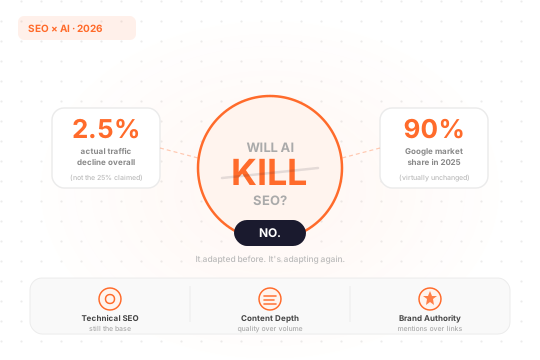
No. SEO is evolving, not dying. The fundamentals of authority, content quality, and technical health are more important than ever. What has changed is the output format of search and the signals that determine visibility in AI-generated answers. Brands that adapt their SEO strategy for this environment will grow. Those that do not will lose ground.
What is the most important SEO change to make in 2026? +
Start structuring your content for AI extraction. Rewrite section openings as direct, quotable statements. Add FAQ schema to your key pages. Build topic clusters instead of isolated keyword pages. These changes improve both traditional ranking and AI citation likelihood.
How do AI Overviews in Google affect my organic traffic? +
For queries where Google shows an AI Overview, click-through rates on organic results below it typically drop. The brands that offset this loss are the ones being cited inside the AI Overview itself. That requires entity authority and structured content, not just ranking.
Does my business need a separate AI search strategy? +
Not a separate strategy, but an integrated one. Your SEO, content, and digital PR programs should all be aligned around the same goal: building the authority and structure that earns visibility in both traditional and AI search. At PS Digital, we treat these as one unified system.
How does off-page SEO help with AI visibility? +
Editorial brand mentions across credible publications tell AI models that your brand is a recognized entity in its category. This is built through digital PR, original research that gets cited by others, and consistent presence on review and comparison platforms. It is one of the most underinvested areas in most SEO programs today.

Founder of PS Digital with 25+ years in digital marketing. Helps businesses build sustainable growth through SEO, paid media, and data-driven strategy.
More from the blog.
Let's talk about your growth.
Get actionable digital marketing insights delivered, or work directly with our team on your strategy.