AI Search Optimization: How to Appear in ChatGPT, Gemini & Perplexity Answers
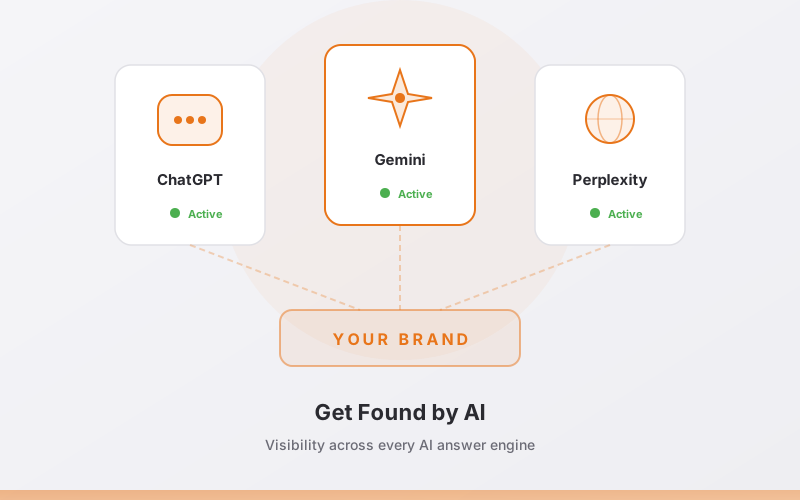
If your brand is not showing up in AI generated answers, you are not invisible by accident. You are invisible by design. That design is shaped by how large language models source, evaluate, and surface information. This article explains exactly how that works and what you need to do about it.
Search Shift Nobody Is Talking About Clearly Enough
Every major shift in how people find information has reorganized which businesses win. PageRank rewarded links. Featured snippets rewarded structure. Now, AI search rewrites your brand story entirely or leaves you out of it.
When someone types a question into ChatGPT, Gemini, or Perplexity, they are not getting a list of links to sort through. They get a curated, synthesized answer. That answer may or may not include your brand. And if it does not, you simply do not exist in that search moment.
This is not a ranking problem. It is an authority and entity problem. And it requires a fundamentally different playbook.
How AI Models Actually Source Information
To optimize for AI search, you need to understand what AI models are actually doing when they generate an answer. There are two main mechanisms at work.
1. Training Data Patterns
LLMs like GPT-4 and Gemini are trained on massive datasets drawn from the web, books, and structured data sources. During training, they learn which entities are credible, which topics are associated with which brands, and which sources are consistently cited as authoritative.
If your brand, product, or perspective appears repeatedly across trusted publications, review platforms, industry forums, and structured content during the training window, the model develops a favorable association with your entity. If you are absent, or only appear in low-signal contexts, you are weighted accordingly.
Think of it this way: training data is the model’s long-term memory. Digital PR and consistent content output build that memory.
2. Retrieval-Augmented Generation (RAG)
Perplexity and the browsing-enabled versions of ChatGPT and Gemini use a process called retrieval-augmented generation. They run a live search query, pull relevant documents from the web, and synthesize an answer from those documents in real time.
This means your content needs to do two things: be discoverable via traditional search signals, and be structured in a way that an AI can parse and quote from easily. More on structure shortly.
Why Traditional SEO Is No Longer Enough
Traditional SEO optimizes for one outcome: getting a human to click on your link from a list of results. The entire discipline – keyword research, meta tags, link building, page speed – is designed around that single interaction.
AI search changes the output format entirely. There is no list of links. There is a paragraph. And in that paragraph, your brand either appears or it does not.
Here is where the gaps show up:
- Backlinks signal authority to Google, but LLMs weight brand mentions in editorial contexts more heavily than raw link counts.
- Keyword optimization helps with retrieval, but if your content is shallow or unstructured, the AI cannot extract a clean answer from it.
- Ranking on page one is useful for RAG-based systems, but if your content is not cited consistently across multiple trusted sources, you will still be omitted.
- Technical SEO alone does nothing to establish your brand as a recognized entity in the model’s understanding.
The brands winning in AI search today are combining topical authority, entity recognition, structured content, and off-site credibility signals. That is a meaningfully broader set of inputs than traditional SEO covers.
Introducing the A.I.R.E. Framework by PS Digital
After working with many clients across SaaS, B2B, and ecommerce brands on AI search visibility, we developed the A.I.R.E. Framework. It covers the four strategic layers that determine whether an AI model knows who you are, trusts you enough to cite you, and retrieves your content when relevant questions are asked.
Establish your brand as a recognized entity across the web through digital PR, editorial mentions, structured entity data, and third-party validation. Authority is what gives the model confidence to include you in an answer.
Structure your content so AI systems can parse, extract, and cite it cleanly. This means using clear heading hierarchies, question-and-answer formats, schema markup, and concise declarative statements that can be lifted verbatim into an AI response.
Ensure your content ranks highly enough in live search to be pulled by RAG-based systems. This includes traditional on-page SEO, topical depth and coverage, internal linking, and crawlability. Retrieval is the gateway – you need to be found before you can be cited.
Demonstrate genuine expertise, authoritativeness, and trustworthiness through attributed content, original research, case studies, and consistent EEAT signals. This is what separates brands that get cited from brands that get ignored.
Each layer reinforces the others. A brand with strong authority but poor information architecture may be known to the model but never quoted. A brand with excellent structure but no retrieval signals will not appear in RAG-based answers at all.
Layer 1: Authority Building and Entity Recognition
In the context of AI search, your brand is an entity. Entities are the named things the model understands: companies, products, people, concepts. Google’s Knowledge Graph has operated on this logic for years. LLMs work similarly.
Building entity authority means ensuring that your brand appears consistently, in credible contexts, across a wide range of sources. This is where digital PR becomes a strategic asset rather than a brand awareness tactic.
A profile piece in a trade publication, a cited statistic from your research report, a founder quoted in a mainstream business outlet – each of these is a data point that tells the model your brand is real, relevant, and credible in your category.
Practical moves under this layer: consistent NAP (Name, Address, Phone) data across the web, Wikipedia presence where warranted, structured data markup using schema.org, regular digital PR outreach targeting editorial rather than just link placement, and review platform coverage on G2, Capterra, Trustpilot, and similar sites.
Layer 2: Information Architecture for AI Retrieval
AI models are extracting answers from your content, not just indexing it. That means your content structure directly affects whether you get cited.
Content that performs well in AI retrieval tends to follow a few patterns. It answers one clear question per section. It uses plain, declarative language rather than marketing-heavy copy. It structures definitions, comparisons, and how-to guidance in formats that can be quoted directly. It uses proper heading hierarchies (H1, H2, H3) so the model can parse document structure.
FAQ sections are particularly powerful for AI retrieval because they mirror the question-answer format that AI systems are generating. If your FAQ asks and answers the exact question a user poses to ChatGPT, there is a strong retrieval signal.
Schema markup matters more than most brands realize. FAQ schema, HowTo schema, Article schema, and Organization schema all provide structured signals that both Google and AI retrieval systems use to parse your content.
One underused tactic: publish a dedicated brand entity page. A well-structured About or Brand page that clearly states who you are, what you do, what category you belong to, and what credible sources have said about you acts as a direct signal to both search engines and language models.
Layer 3: Retrieval Signals and Topical Authority
For AI systems that use live web retrieval, traditional SEO still matters, but the goal has shifted. You are no longer just trying to rank for individual keywords. You are trying to establish topical authority across an entire subject area.
Topical authority means your site comprehensively covers a subject in depth, with connected content that signals expertise. A SaaS company that has written 80 well-structured articles across every angle of customer success is more likely to be retrieved across a wide range of queries than one with 10 high-ranking articles on individual keywords.
The content cluster model is your execution framework here. Choose the core topics that matter for your category. Build pillar content. Build supporting articles. Link them intelligently. This creates a topical map the model can rely on.
Speed, mobile performance, and crawlability remain baseline requirements. If your content cannot be indexed cleanly, it cannot be retrieved.
Layer 4: EEAT and First-Party Credibility Signals
Google introduced the concept of Experience, Expertise, Authoritativeness, and Trustworthiness (EEAT) as a quality signal for human raters. LLMs have internalized similar logic, even if less explicitly defined.
For AI search, EEAT means your content needs to demonstrate genuine expertise and be attributed to real, credible people or institutions. Anonymous content, thin content, and content that could have been written about any brand in your space performs poorly.
Practical execution: author bios with verifiable credentials, original research and proprietary data, case studies with real outcomes, quotes from subject matter experts, and content that takes clear positions based on experience rather than hedging everything.
First-party data is becoming a differentiator here. If you publish a survey, a benchmark report, or an industry study that gets cited by other publications, you are building EEAT and entity authority simultaneously. Other sources citing your data is one of the strongest signals an AI model can receive.
Semantic Search and Why Topical Clusters Beat Keyword Targeting
Semantic search is about understanding meaning and intent, not just matching words. When Perplexity receives a query about onboarding automation for SaaS, it is not looking for a page with that exact phrase. It is looking for content that demonstrates a deep understanding of the concept, the problems it solves, and the solutions available.
This is why keyword stuffing has zero value in the AI era, and topical depth has enormous value. A content library that genuinely covers a subject, addressing edge cases, comparisons, counterarguments, and nuance, will consistently outperform a content library optimized around individual search phrases.
Build content for humans who care about the subject, and structure it so AI systems can parse it. Those two goals are not in conflict. They are the same goal.
The Case for Integrated SEO, Paid, and Tracking in the AI Era
One of the most common mistakes we see is brands treating AI search optimization as a separate channel or a content team project. It is neither. It is the output of a fully integrated growth system.
Organic visibility in AI search depends on entity authority built through PR, content depth built through a strategic SEO program, and retrieval signals maintained through technical and on-page optimization. Paid search amplifies content through retargeting and brand awareness, reinforcing the brand signals that AI models pick up on. Tracking systems tell you which content formats and topics are generating genuine engagement versus shallow pageviews – and that distinction matters when you are optimizing for AI retrieval rather than just rankings.
At PS Digital, we work at the intersection of all three. Our approach combines SEO and topical authority programs with performance marketing and attribution that accounts for AI-influenced buyer journeys. The brands winning in this environment are not treating search, content, and paid as separate functions. They are running them as one integrated system with a shared visibility goal.
The AI search era rewards brands that have earned genuine authority, created genuinely useful content, and built the infrastructure to be found and cited at scale. That has always been the right strategy. Now it is the only one.
Frequently Asked Questions
Build entity authority through editorial mentions in credible publications, structured schema markup, consistent brand presence across review platforms, and deep topical content that AI systems can retrieve and cite. There is no shortcut – it requires sustained content and digital PR investment.
Yes, especially for retrieval-augmented AI systems like Perplexity. SEO ensures your content can be found and retrieved. But traditional SEO alone is not sufficient , you also need entity authority, structured content, and EEAT signals that go beyond ranking.
Backlink authority signals to Google’s algorithm that your content is trusted. Entity authority signals to AI models that your brand is a recognized, credible entity in its category. The latter is built through editorial mentions, consistent brand presence, structured data, and citation patterns across diverse sources.
Entity and authority signals accumulate over time, similar to domain authority in traditional SEO. A focused digital PR and content strategy typically begins to show measurable visibility improvements within three to six months. Training data cycles vary by model, but retrieval-based visibility can improve more quickly.
The core principles are consistent across all three. Perplexity relies more heavily on live retrieval, so traditional SEO signals matter more there. ChatGPT and Gemini weight training data more heavily, so long-term entity authority and editorial presence drive visibility. A unified A.I.R.E. strategy addresses all three.

Founder of PS Digital with 25+ years in digital marketing. Helps businesses build sustainable growth through SEO, paid media, and data-driven strategy.
More from the blog.
Let's talk about your growth.
Get actionable digital marketing insights delivered, or work directly with our team on your strategy.