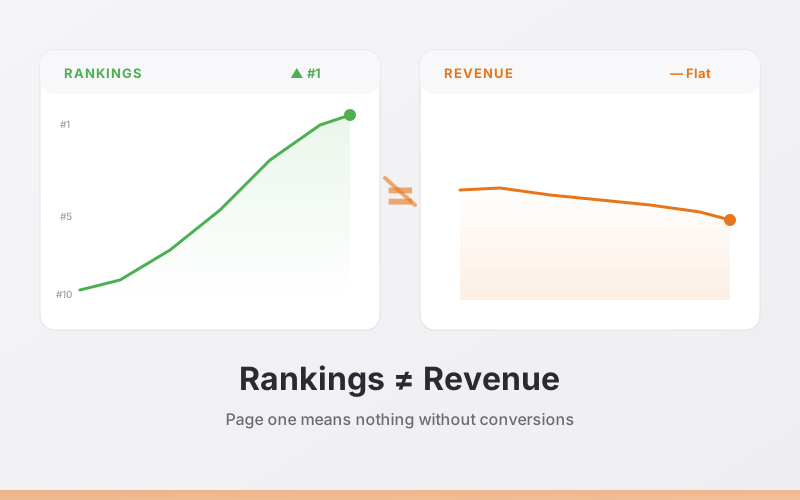
Your website is ranking on page one of Google. Maybe even position one or two for a keyword you worked months to target. Traffic is coming in. The SEO report looks great.
And yet the enquiries are not coming. Sales are flat. The business is not growing the way you expected it to when you first invested in SEO.
You ask your agency. They point to the rankings. They point to the traffic. Everything looks fine on their dashboard. But your revenue tells a different story.
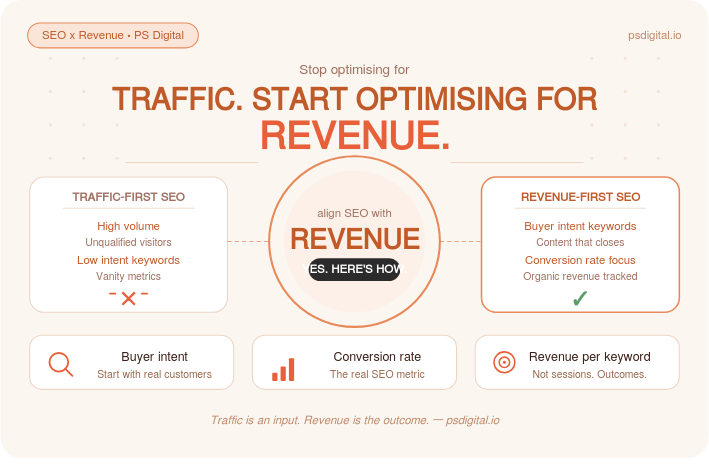
This is one of the most common and most frustrating situations in digital marketing. And it happens because of one fundamental misunderstanding: rankings are not revenue. Traffic is not revenue. Only conversions are revenue.
This article explains exactly why high rankings fail to produce results, and what to do about each one.
The Uncomfortable Truth About SEO Metrics
Most SEO reporting is built around three numbers: rankings, traffic, and impressions. These are the metrics that look impressive in a monthly report. They are also the metrics furthest removed from actual business outcomes.
A ranking tells you where your page appears in search results. It says nothing about whether the person who finds it is a potential customer, whether they stay on the page, or whether they ever come back.
Traffic tells you how many people visited. It says nothing about whether those people had any intention of buying, enquiring, or engaging with your business.
Here is something that should change how you think about SEO: research from Grow and Convert tracking multiple clients through 2025 found a pattern of more rankings and more impressions, yet declining clicks and flat conversions. Visibility went up. Revenue did not follow. The gap between the two is exactly what this article is about.
Rankings are the beginning of the journey, not the destination. What happens after the click determines whether that ranking was worth anything at all.
6 Reasons Your Rankings Are Not Turning Into Revenue
Reason 1: You Are Ranking for the Wrong Keywords
Not all searches carry the same intent. Someone typing ‘how does term insurance work’ is trying to understand a concept. Someone typing ‘best term insurance plan for 35-year-old salaried person’ is much closer to making a decision. Both can be ranked for. Only one will convert into business.
The problem is that informational keywords are often easier to rank for. They have clear questions, defined answers, and less commercial competition. So SEO strategies naturally drift toward them because they produce rankings faster. Those rankings feel like progress. But they attract people in research mode, not buying mode.
A financial advisory firm in Bangalore ranked number one for ‘how to save tax in India’, a term that gets significant search volume every year. Their organic traffic doubled. Their lead form submissions barely moved. The people searching that term wanted a quick answer, read the article, and left. They were not looking for an advisor. They were looking for information.
The fix:
Audit every keyword you are currently targeting and ask one honest question: at the moment someone types this, are they likely to be interested in spending money? If the answer is no or not yet, that content serves awareness, not conversion. It has a place in your strategy but it should not be mistaken for commercial SEO. Prioritise keywords that signal intent to act, searches that include words like ‘best’, ‘hire’, ‘cost’, ‘near me’, ‘service’, or the name of a specific product or outcome.
Reason 2: The Page Ranks But the Experience Drives People Away
Getting someone to click your result is only half the job. What they find when they land is what determines whether they stay, read, trust you, and take action.
Page speed alone is a significant factor here. Research consistently shows that 70% of consumers say page speed influences their purchasing decisions. On a mobile connection in India, a page that takes more than 3 seconds to load loses a significant portion of its visitors before they have seen a single word of content.
But speed is just the start. A page that loads fast but presents a wall of text, no clear structure, no obvious next step, and a design that feels outdated will still drive people away. Bounce rates above 70% for organic landing pages are a strong signal that visitors are arriving and immediately deciding this is not what they were looking for.
The fix:
Open your top-ranking pages on a mid-range Android phone on a mobile data connection. Not on your office WiFi. Not on your laptop. That is the experience most of your Indian visitors are having. Ask yourself honestly: does this load fast enough to wait for? Is it immediately clear what this page is about and what I should do next? Is there one obvious action for me to take? If any answer is no, the page is leaking conversions regardless of its ranking.
To understand overall health of a page, you can utlize tools like GT-metrix and page speed insights for detailed report
Reason 3: Your Content Answers the Question But Does Not Earn the Next Step
Good SEO content answers the question the searcher came with. Great SEO content answers it and then earns the trust and curiosity to go further.
Most content stops at the answer. It informs but does not persuade. It educates but does not build a relationship. The visitor reads what they came for and has no reason to do anything else on the page. So they leave. They got what they needed. You got a pageview. Nobody got a customer.
This is especially common with blog content and informational articles. The strategy is to rank, attract traffic, and hope that some of those visitors eventually convert. But without a deliberate bridge from the content to a relevant next action, most of them will not.
The fix:
Every piece of content should have one logical next step built into it. Not a generic ‘contact us’ button in the footer. A specific, relevant offer that connects directly to what the person just read. If someone read an article about choosing the right school management software, the next step might be a free checklist of what to evaluate, or a short demo of your own product. If someone read about tax planning strategies, the next step might be a free 20-minute call to review their specific situation. Make it easy, make it relevant, and make it visible within the content itself.
Reason 4: You Are Ranking in the Wrong City or for the Wrong Audience
This one is surprisingly common in India and surprisingly easy to miss.
A business that serves clients in Pune ranks well for a keyword that attracts visitors from Delhi, Kolkata, and smaller towns where the service is not available or not relevant. The traffic numbers look healthy. The conversion rate is near zero. Geography is the entire explanation.
The same problem appears with audience mismatch. A premium interior design firm ranking for ‘affordable interior design ideas’ attracts visitors looking for DIY inspiration or budget options. The firm is not affordable. The visitor is not the right customer. The ranking produces traffic with no commercial value to either side.
The fix:
Check your Google Search Console and Google Analytics data and filter organic traffic by location. If a significant portion of your visitors are coming from cities or states where you do not operate, your keyword targeting has a geography problem. Add location modifiers to your target keywords. Build location-specific pages where relevant. And review the intent behind every high-traffic keyword. Make sure the audience searching it is the audience you can actually serve.
Reason 5: AI Overviews Are Answering the Question Before Anyone Clicks
This is a relatively new problem but one that is growing fast and hitting Indian businesses harder than many realise.
Since Google expanded AI Overviews across India in 2025, many search queries now return an AI-generated summary at the very top of the results page. The summary answers the question directly. For a large number of informational searches, the user gets what they came for without clicking any result at all.
Some estimates put the potential organic traffic decline from AI Overviews at up to 30% for affected queries. The searches hit hardest are exactly the ones most SEO strategies have been built around: how-to content, comparison guides, definitions, and explainer articles.
If your rankings are built primarily on informational content, AI Overviews may already be absorbing a significant share of the clicks you used to receive, without any change in your position or any warning in your rankings report.
The fix:
Shift your SEO focus toward content that AI Overviews cannot easily replace. Detailed case studies, original research, specific product or service comparisons, and content based on real experience and expertise are harder for AI to summarise adequately. More importantly, double down on commercial-intent content where the searcher is specifically looking for a business to hire or a product to buy. These queries are less likely to be resolved by a summary because the user’s goal requires an action, not just an answer.
Reason 6: The Offer or the Trust Signal Is Missing
Someone lands on your page. The content is good. The page loads fast. They read everything. They are genuinely interested.
And then they leave without enquiring. Not because they do not want what you offer. Because they are not yet sure they trust you enough to give you their phone number or fill in a form.
This is one of the most overlooked conversion problems in SEO. The traffic quality is fine. The content is fine. But the page gives the visitor no specific reason to trust this particular business over every other option they found in the same search.
No reviews. No real client names or outcomes. No face behind the business. No indication of who has worked with you or what happened when they did. Just a services page and a contact form.
The fix:
Add trust signals directly onto the pages that are driving your organic traffic, not just the homepage. Real client testimonials with names and specific outcomes. Case studies that describe a before and after. A team photo or founder introduction that puts a face to the business. Any third-party recognition, awards, or press mentions. In India, where word-of-mouth and social proof carry enormous weight in purchase decisions, the absence of these signals on a landing page is often the single biggest reason qualified visitors do not convert.
The Bigger Picture: Rankings Are a Starting Point, Not a Finish Line
SEO has long been sold on the promise that rankings equal results. Get to page one, the logic goes, and the business takes care of itself. That was never entirely true, and in 2025 it is less true than ever.
Ahrefs research shows that 68% of online experiences still begin with a search engine. Search is not going away. Organic visibility is still genuinely valuable. But the relationship between ranking and revenue has more steps in it than it used to, and every one of those steps is a place where visitors can be lost.
Rankings get you seen. Everything that follows determines whether being seen turns into being chosen.
The businesses winning at SEO in India right now are not just the ones ranking highest. They are the ones who have thought carefully about what happens after the click. The page experience. The content quality. The trust signals. The next step. The offer. All of it working together to turn a visitor into an enquiry and an enquiry into a customer.
That is not SEO in the traditional sense. It is SEO as a complete commercial system, where rankings are the entry point and revenue is the only metric that actually matters.
Start Here: A Quick Audit of Your Own Rankings
If you are getting traffic from organic search but not seeing it translate into leads or sales, work through these questions honestly.
Are your top-ranking keywords commercial or informational? If most of them are informational, your rankings are building awareness but not demand. That is not worthless, but it is incomplete.
What does your top organic landing page look like on a mobile phone on a slow connection? Load it now and time it. If it takes more than 3 seconds, you are losing a meaningful share of your visitors before they engage.
Does every high-traffic page have a specific, relevant next step? Not a footer link. A visible, contextual call to action that connects directly to the content the visitor just read.
Where is your organic traffic coming from geographically? Filter by city in Google Analytics. If significant traffic is coming from locations you cannot serve, your rankings are producing noise rather than signal.
What trust signals are visible on your organic landing pages? If a first-time visitor cannot find evidence of real clients, real results, or real people within the first scroll, that is worth fixing before anything else.
These questions will not take long to work through. The answers will tell you more about why your SEO is not converting than any rankings report will.
Rankings Are Not the Goal. Revenue Is.
There is nothing wrong with wanting to rank well on Google. High rankings are useful. They put you in front of people who are actively searching for what you offer. That is genuinely valuable.
But a ranking is an opportunity. What you do with that opportunity, the page you send people to, the content they find, the trust you build, the action you make easy, determines whether the opportunity becomes revenue or just another data point in a monthly report.
The businesses that understand this stop asking ‘how do we rank higher?’ and start asking ‘what happens to the people who find us?’ When the answer to that second question is solid, rankings and revenue move together. Until then, they will keep moving separately.
Fix what happens after the click. That is where the revenue is.
If your SEO is ranking but not converting, the problem is rarely the ranking itself. Get in touch with the PS Digital team for an honest audit.

Founder of PS Digital with 25+ years in digital marketing. Helps businesses build sustainable growth through SEO, paid media, and data-driven strategy.
More from the blog.
Let's talk about your growth.
Get actionable digital marketing insights delivered, or work directly with our team on your strategy.